Chris,
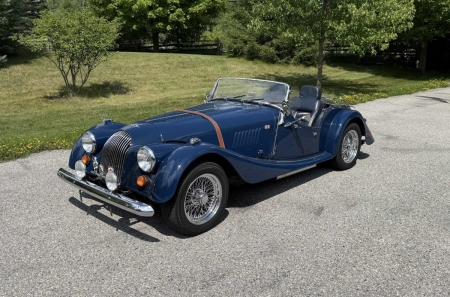
Regarding AVO settings there is another interesting thread on GAZ shock settings started by Peter (Gambalunga) in this area of TM. What you set them to is down to personal preference, I'm currently using 2 clicks at the front and 1 click at the rear on AVOs fitted to a 2005 Plus 4.
There is also some information on the GoMog site. They recommend, for the so called "Rutherford AVOs", zero clicks front and rear. But, for me, this begs the question why bother with adjustables?
Regarding the condition of your shocks, I have not had the AVOs off my Morgan, and can only speak from experience with some Spax adjustable coil over dampers. I had a pair of "tired" dampers I took off the car. I could open and close them very easily by hand through the initial part of the operating range, virtually no effort needed. Beyond this they needed quite considerable effort by hand, but would move steadily. Replacing them made an incredible difference to the cars handling.
Re your question as to whether the adjusters make any difference to hand operation. The shock absorber "valves" are designed to control the damper fluid movement between the internal chambers to control the change of the position of the damper piston. The external adjuster on the AVOs alters the "valves" relative resistance to internal damper fluid movement between the chambers thus adjusting the rate of change of the shocker piston to a particular load. The higher the number of clicks on the adjuster, the "tighter" the "valves" setting, and the greater the shock resistance to movement. So, I would expect that there should be some discernible difference to the effort needed by hand, particularly at the high click settings.
Finally, most non-adjustable shock absorbers are built by the manufacturers with a fixed ratio for the "valves" resistance between bump (compression) and rebound (extension). This is also true for the single adjuster shocks such as the AVO and GAZ dampers popularly fitted to Morgans. These ratios vary, typically where the bump resistance is equal to rebound resistance (1:1) through to bump resistance being a quarter the bump resistance (1:4) depending on intended use (e.g. road or track). I don't know what the AVOs are built to, but they are probably a typical road set up of 1:2 or similar. If you alter the clicks setting you are adjusting the resistance to both the bump and rebound rates. So, when you make adjustments it will always be a compromise between the bump rate you want and the rebound rate you want, and between comfort and control. The exception to this is for the far more expensive race shockers that have separate bump and rebound rate adjustment screws.
Hope this is useful,

MZ










 - will try again tomorrow for drivers side as I have a bit more time for arm contortions tomorrow). Probably will go back to 4 on front, but it's interesting seeing how the car tackles the same road-repair bumps with the various setting.