|
|
|
|
|
|
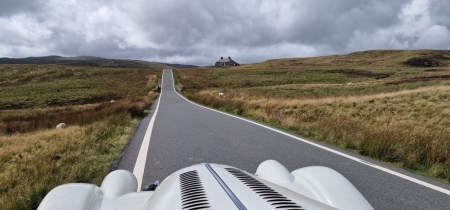
Wales
by Joske Vermeule, September 1
|
|
|
|
|
Forums39
Topics49,901
Posts838,046
Members9,635
| |
Most Online1,063
Jun 14th, 2026
|
|
|
There are no members with birthdays on this day. |
|
|
|
Joined: Oct 2011
Posts: 3,564 Likes: 13
Talk Morgan Addict
|
OP

Talk Morgan Addict
Joined: Oct 2011
Posts: 3,564 Likes: 13 |
I have found my brake pedal a little too soft for my liking, and I note there have been some comments along the same lines in the past, I'm wondering if someone makes a different master cylinger size to firm the pedal and give less movement.
I have taken the following information from another forum [OK the Lotus Seven Club] which is quite informative:
"Reproduced from CBS on line
A common question is 'What bore size master cylinders should I use?
In theory, it is possible to determine the correct size of the master cylinder (piston diameter) by calculating pedal ratio, pedal travel and caliper piston diameters but it's often easier to 'suck it and see' by choosing a .750" master cylinder to begin with and working from there.
Many factors will determine the optimum master cylinder size such as weight of the vehicle, tyre diameter, brake pedal length, weight distribution and servo or non- servo assistance. Brake pedal ratio is often the easiest parameter to change. Increasing the pedal length is, in effect, increasing the leverage but the pay-off is less fluid movement for a given pedal travel. If the pedal is 12" long from the fulcrum to the foot pad and the cylinder push rod is 3 inches from the fulcrum then the pedal has a 3 to 1 ratio. Increasing the ratio to say 4 to 1 will give more leverage but with longer pedal travel.
For a clutch the same rules apply to the release fork. A higher ratio will make the clutch action easier but there will be less travel of the release bearing. Determine the distance the release bearing has to travel to fully disengage the clutch (usually about 10mm) and work backwards from there.
A release fork with 2 to 1 ratio will require 20mm travel of the slave cylinder.
Brake hydraulics is really all about fluid movement so, to give you an idea of the effect of changing master cylinder sizes, here's a chart of how much fluid each size master cylinder moves with each l cm travel of the push rod.
You can see that a 1" cylinder will move 2 ½ times more fluid than a .625" cylinder. But the pedal will require 2 ½ times more force to get the same braking performance.
However, the pedal travel will be 2 ½ times less.
Cylinder Piston Diameter Fluid movement for 1cm of piston travel
0.625 ( 5/8”) 1.98cc
0.75 (3/4”) 2.85cc
0.825 (7/8”) 3.45cc
1” 5.06cc"
So a bigger MC is not necessarily the best thing. It all depends and is one available anyway.
Can anyone identify the m/c that Morgan use?
Paul
[At last, I have a car I can polish]
|
|
|
|
|
Joined: Jun 2013
Posts: 1,461
Has a lot to Say!
|
|
Has a lot to Say!
Joined: Jun 2013
Posts: 1,461 |
I don't know the size, but the entire braking system is from Caparo, if that's any help.
|
|
|
|
|
Joined: Apr 2013
Posts: 1,213
Has a lot to Say!
|
|
Has a lot to Say!
Joined: Apr 2013
Posts: 1,213 |
I've always found my brakes to be fine ( apart from the pedal breaking !) there seems to be a good amount of feel to me . It's quite easy to lock the front wheels especially in the wet , so I don't like the idea of any less movement .
I imagine you've already tried bleeding yours Paul ?
Hugh
|
|
|
|
|
Joined: Jan 2014
Posts: 1,075
Has a lot to Say!
|
|
Has a lot to Say!
Joined: Jan 2014
Posts: 1,075 |
Most aftermarket off road pedal assemblies that are similar to the M3W are in the 5:1 all the way up to 7:1. The most popular seems to be the 6:25 ratio.
But really, if the caliper is working correctly, the pad basically just about rubs the rotor. So tons of fluid volume is not needed, but pressure is. The slightly smaller diameter master will net you more pressure at the caliper, but if the pads are too far away from the rotor the extra pedal stroke to move the pads to the rotors will take away from your high harder pedal.
Now the drum rears could be at fault as they tend to be more relaxed in run mode and usually have to move a bit further to make contact with the drum. I'm not sure about the auto adjuster system in the rear drum. Some of the older domestic drum brakes would only "adjust" when you were in reverse and pressed hard on the pedal. This would trigger the ratcheting star to unthread a bit to take up the slack.
If your brakes were sufficient at the beginning and now seem to be a bit mushy, it's probably something mechanical that's happened to cause more pedal travel.
I don't know what DOT fluid is used, but if it's DOT 5, that's silicone based and it's a PITA to bleed and to ever get a hard pedal. Most bike guys with DOT 5 drain and go to DOT 4. But IF your system is the silicone based DOT 5, you would need to completely flush the lines and calipers to use the DOT 4 fluid. Also DOT 4 or DOT 3 will eat your paint aggressively so be careful of that.
This probably is not new news to you and may not help you much.
Good luck with your pedal issue.
Dan
|
|
|
|
|
Joined: Apr 2014
Posts: 3,550 Likes: 5
Talk Morgan Addict
|
|
Talk Morgan Addict
Joined: Apr 2014
Posts: 3,550 Likes: 5 |
When was the last time the system was completely flushed?
Light or little use of the car will make no difference on the life of brake fluid.
It should be changed at least every two years.
Mark - No Longer driving Archie the Old English Sheep Mog........... 2010 Roadster 3.0 V6 (S3) 
|
|
|
|
|
Joined: Oct 2012
Posts: 2,822 Likes: 155
Talk Morgan Expert
|
|
Talk Morgan Expert
Joined: Oct 2012
Posts: 2,822 Likes: 155 |
I did a proper job of flushing and bleeding the system a couple of weeks ago and got a pretty much rock solid pedal with lots of feel. Some of the bubbles took a bit of persuasion to get out.
|
|
|
|
|
Joined: May 2012
Posts: 1,796 Likes: 5
Talk Morgan Enthusiast
|
|
Talk Morgan Enthusiast
Joined: May 2012
Posts: 1,796 Likes: 5 |
I too have bled air out together a better pedal as I thought it felt too mushy
|
|
|
|
|
Joined: Oct 2011
Posts: 3,564 Likes: 13
Talk Morgan Addict
|
|
OP
Talk Morgan Addict
Joined: Oct 2011
Posts: 3,564 Likes: 13 |
Yes, I guess the first thing to do is to bleed the existing system properly. I've no complaints about the ultimate stopping power, just the pedal feel, which is a personal thing. I like a hard pedal with little movement, others prefer it softer with more travel.
I'll report back as and when I bled it.
Paul
[At last, I have a car I can polish]
|
|
|
|
|
Joined: Aug 2013
Posts: 115
L - Learner Plates On
|
|
L - Learner Plates On
Joined: Aug 2013
Posts: 115 |
Unless you are racing your M3 changing to dot 5 or four will be a waste of time and money. Dot 3 boils at around 400 degrees, dot 4 450ish and dot 5 500.
If your pedal is mushy as soon as you start to drive (cold) it's not a fluid issue, as long as the fluid is fresh and not water laden.
Dot 3and4 absorb water right from the air.
I would start with checking the shoe adjustment on the rear drum. By design the return springs on drum brakes pull the shoes all the way back away from the drum. As the shoes wear it takes more pedal movement to take up the gap between the shoe and drum.
Disk brakes do not retract the pads so as they wear the "gap" is taken up by more fluid in the caliper and the reservoir level goes down.
On the drum adjust the shoes so they drag slightly then pump the pedal and recheck the drag. It may take a few adjustments before it is at its best. This is due to the non symmetrical movement of the shoes against the drum. The shoes have to realign themselves in the drum
A little drag, very slight is fine. As the drum heat up it will expand and grow in diameter.
DOG is my Co-Pilot
|
|
|
|
|
Joined: Oct 2011
Posts: 3,564 Likes: 13
Talk Morgan Addict
|
|
OP
Talk Morgan Addict
Joined: Oct 2011
Posts: 3,564 Likes: 13 |
Great advice, makes it all sound so simple. Thanks.  
Paul
[At last, I have a car I can polish]
|
|
|
|
|