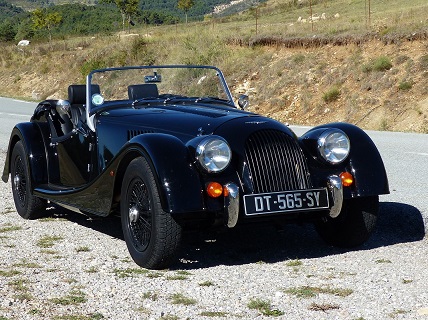
The Morgan suspension, commonly called sliding pillar, is actually a sliding hub. The pillar is fixed, the king pin, the hub slides on it. There were other systems in which the hub was fixed to the kingpin and the whole assemblý slide up and down in bushes fixed above and below.
Peter. The BMW Telelever front suspension is an English invention by Saxon-Motod. It is an excellent system and I am surprised that other manufacturers don't use it.
PS. I should also have mentioned that the Earles fork used on many vintage bikes and more recently sidecar outfits is also an English invention.
Last edited by Gambalunga; 07/01/1510:36 PM. Reason: PS
I think BMW patented it or have, in some way, IP ownership. There was some negative noise in the bike world 10 or 15 years ago to the effect BMW "stole" the design and the English inventors got little or nothing.
I agree, it works very well: the inherent "anti dive" nature is a delight on a bike.
Peter, 66, 2016 Porsche Boxster S No longer driving Tarka, the 2014 Plus 8...
I think BMW patented it or have, in some way, IP ownership. There was some negative noise in the bike world 10 or 15 years ago to the effect BMW "stole" the design and the English inventors got little or nothing.
I agree, it works very well: the inherent "anti dive" nature is a delight on a bike.
Originally Posted By Jays
Peter, I think you are referring to the BMW Duolever system which was a copy of the Hossack design, introduced on the K1200S.
The BMW Telelever is a variation on the original Saxon design. If I recall correctly in the end BMW did pay for rights. How much and in what way I do not know. Actually I believe Yamaha also used a Saxon based system on one of their bikes.
Then another British design, the Hossack system. It is interesting that BMW have used three British developed anti-dive systems; Earles, Saxon, and Hossack.
As an interesting comparison check out this system developed by Guzzi about 80 years ago.
Three spring rising rate front girder suspension with friction damping.





![[Linked Image]](http://bradley.it/public_images/drive.jpg)