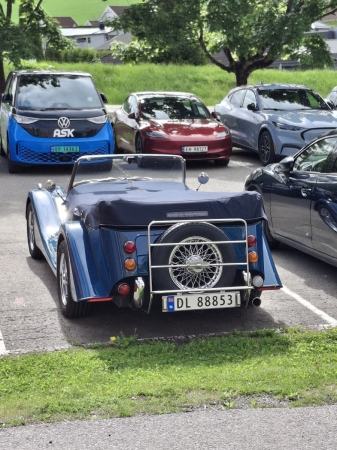
Whilst Morgan have successfully developed a new customer base of people that have a little discretionary money to spend they are a long way from their popular origins.
In 1950 a Plus 4 was priced at £625, admittedly that was double the cost of Ford Anglia, the cheapest 4 wheeled car available, which cost £310. The Anglia was probably the equivalent of today's Ford Fiesta that is priced at around £13,000 to £14,000. The 1950 Plus 4 would be about £20,000 in today’s money.
This really shows how Caterham with the Seven 310 and the Seven 360 at starting prices of £22,995 and £24,995 respectively are much closer to the original market sector of Morgan. I chose those two models because they are probably the nearest equivalent of the Plus 4. Certainly the Caterham is much more "hard edged" than the Morgan and you would have to add a few £K to the price, to get hood, sidescreens etc., to bring it up to the equivalent base Morgan.
I can't find a 1950 price for the MG TD but the 1947 price of the TC was £527. No doubt my father paid very little more when he ordered a blue TC at the Earls Court show for delivery in Australia. He looked at the Morgan but was worried about the durability of the wood frame on the "rough Australian roads".
Interesting Peter but on the 1950 cost vs today
according to the FT We need a factor of 20.5 to get to today’s cost with inflation
So I would argue that The Ford Anglia being the cheapest car at the time is the now the equivalent to the Dacia Sandero which is now the cheapest car at just under £7K but it shows that all cars have gone up greater than inflation
In fact if the Ford Anglia is the equivalent to a Fiesta which I agree with then the Fiesta has more than doubled OVER the cost of inflation.