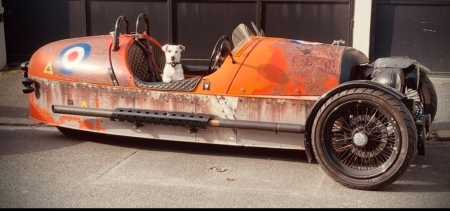
Honing marks are visible over most of an engines life, say for at least the first 70%, perhaps as high as 80-90% of its nominal lifespan. On an air cooled twin like the X-wedge in the M3W I would guesstimate that lifespan at 50-60k miles unless it's mostly highway miles, in which case I would go higher.
During the break in period, which is typically very short with modern rings, the 'peaks' left behind by the honing process are quickly worn down while the (visible) grooves remain. These are an essential component of maintaining an oil film on the cylinder walls during operation. As the miles pile up, eventually the cylinders will wear smooth, blow-by will increase, and effective compression will reduce.
As an example, on my last BMW which I sold at ~185k miles, the purchaser did a comprehensive pre-sale inspection including a boroscope which still showed a visible, but fading crosshatch pattern. (synthetic oil changed every 5k).
So visible crosshatch grooves are in no way an indication of 'break-in' per se on a modern FI engine using modern oils and piston rings.
For those raised in the days of carburetors, significant bore wear (i.e. crosshatch gone) could occur well before 100K miles, as this was primarily down to the imprecision of carburetion and the resulting 'bore wash' from excess fuel during much of the running cycle. Modern Fuel Injection (FI), aided by better compression ring material and oils, have done wonders to extend engine life.
Last edited by Bitsobrits; 13/08/23 04:11 PM.