I am sorry but the long and short sender both use the same wire guage and are the same resistivity. The 280mm sender cannot have an advantage.
Charles, hello.
Either I'm missing something in the way you're suggesting that long sender versus short sender make no difference in true tank fuel level, then please explain what I'm missing.
I've done a quick sketch in AutoCAD to show what I'm thinking.
To take it to the extreme, I also represented a 100mm long VDO sender.
Now less assume that each of these are calibrated to allow the dash gauge to read 0% fuel at the bottom of the sender.
You can clearly see that at 0% on the 280mm you will be closer to the bottom of the tank and hence there will be less fuel in the tank at that reading.
The extreme would be the 100mm and when it's at the bottom of its range, it too would give the gauge a reading of 0%. Again you can see in that case that the 100mm at the bottom of its useful range, you would still have well over half a tank of fuel.
So you suggestion that it's not an advantage to use the 280mm sender, doesn't make sense to me, please explain.
My sketch does assume that all three senders are in fact working the way they are supposed to and for the given application would give out the correct resistance for any travel within their useful range.
The display only measures a voltage. What Charles is saying is that both gauges use the same resistance wire per unit length. I.e. for any given drop they both read the same resistance/voltage. Therefore they both read full at the top, and they both read zero at the same level down the sender. The longer unit will continue to vary voltage as the level decreases, but at this point the display will already be reading zero.
2012 G56 Stage 2 M3W 2007 Fiat Panda 100HP 1998 Lotus Elise (Cosworth Duratec) 1988 RF88 Van Diemen
Or to put it another way, your assumption is that they all read 0% at the bottom of the sender. They don't. They all read 0% at the same height down the sender.
2012 G56 Stage 2 M3W 2007 Fiat Panda 100HP 1998 Lotus Elise (Cosworth Duratec) 1988 RF88 Van Diemen
Or to put it another way, your assumption is that they all read 0% at the bottom of the sender. They don't. They all read 0% at the same height down the sender.
Yours and Charles assumption is that the resistance wire has exactly the same properties (not necessarily gauge) from one sender length to another. Since VDO offer senders in the range 150mm to 800mm length but with a much lesser resistance range, it suggests differing wire resistivity is spec'd through the range.
Add to the above the findings by planenut that the two senders in question measure a similar resistance. Consequently both he and seemingly most others that fitted the 280mm sender, including myself, noticed an increase in fuel indication immediately after fitting. Not a perfect solution but a useful increase in mileage through the indicated range.
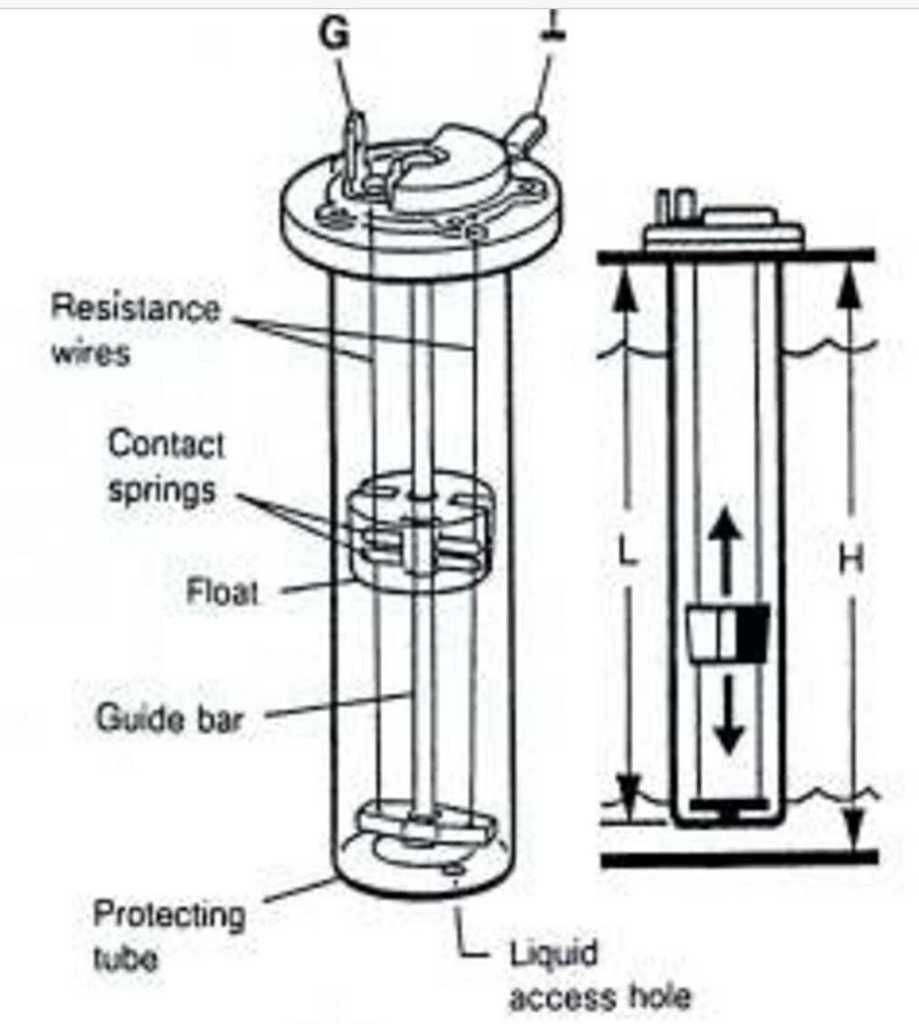
This image shows how the sender works with two parallel resistance wires connected to each of the ground and signal terminals at the top but isolated at the bottom. These in turn being shorted together at any point between upper and lower limits by contacts on the float, and so giving a linear varying resistance.
Richard
2018 Roadster 3.7 1966 Land Rover S2a 88 2024 Royal Enfield Guerrilla 450 1945 Guzzi Airone