|
8 members (JoeSpeetjens, MJF, Saxonian, Julian BB, DaveW, MATTMOG, GrumpyPa, Hamwich),
220
guests, and
90
robots. |
|
Key:
Admin,
Global Mod,
Mod
|
|
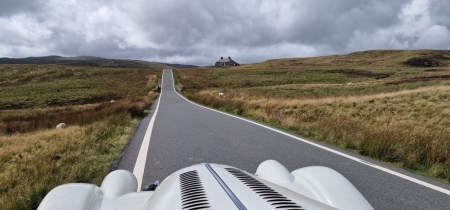
Wales
by Joske Vermeule, September 1
|
|
|
|
|
|
|
|
|
|
|
Forums39
Topics49,872
Posts837,691
Members9,596
| |
Most Online1,063
Jun 14th, 2026
|
|
|
|
Joined: Oct 2015
Posts: 1,490
Has a lot to Say!
|

Has a lot to Say!
Joined: Oct 2015
Posts: 1,490 |
Especially noted when 2-up (ie an extra 400+lbs weight!). ... Dayum...how'd you get a 400+!pound passenger in next to you?  thats the payload over the dry weight. Includes the portly driver! Hmmm could be 500lb then... I knew what you meant, lol. But the way you wrote it, you were comparing "two up"... Extra 400 pounds, to how it performed empty. I was wondering how you experienced that phenomenon!😂
The Original Ken
11,000 miles.
2014 BMW R9T
2005 Saabaru
2005 Saabaru
|
|
|
|
|
Joined: Mar 2016
Posts: 213
L - Learner Plates On
|
|
L - Learner Plates On
Joined: Mar 2016
Posts: 213 |
I originally loosened the adjuster nuts one full turn as the belt was fiddle string tight. On the test drive I started on a steep hill at an intersection, heard a hell of a squeal and smelled burning rubber. Thought I may have slipped the belt. I re-tightened the belt adjusters 1/2 turn, and have come to realize it is fairly easy to just spin the rear tire on acceleration ie squealing out and burning rubber. No gun shot noises.
Inge
|
|
|
|
|
Joined: Oct 2015
Posts: 1,490
Has a lot to Say!
|
|
Has a lot to Say!
Joined: Oct 2015
Posts: 1,490 |
I originally loosened the adjuster nuts one full turn as the belt was fiddle string tight. On the test drive I started on a steep hill at an intersection, heard a hell of a squeal and smelled burning rubber. Thought I may have slipped the belt. I re-tightened the belt adjusters 1/2 turn, and have come to realize it is fairly easy to just spin the rear tire on acceleration ie squealing out and burning rubber. No gun shot noises. I still have trouble NOT burning rubber off the line some times.
The Original Ken
11,000 miles.
2014 BMW R9T
2005 Saabaru
2005 Saabaru
|
|
|
|
|
Joined: Jul 2013
Posts: 3,732 Likes: 79
Talk Morgan Addict
|
|
Talk Morgan Addict
Joined: Jul 2013
Posts: 3,732 Likes: 79 |
There's an article in this month's Mogmag about installing the engine and gearbox.
The chap who puts it all together says of the Centra drive that "...there are large rubber bushes which rotate when put under too much stress..."
There's also a picture of the unit being assembled and it looks as if the bushes could be compressed enough to allow some rotational slip. Might this be the cause of the occasional bang from the transmission?
I get it occasionaly, usually going from overun to picking up the throttle again at too low revs which could fit with the centra "slipping".
Red Leader 
|
|
|
|
|
Joined: Jan 2014
Posts: 1,075
Has a lot to Say!
|
|
Has a lot to Say!
Joined: Jan 2014
Posts: 1,075 |
There's an article in this month's Mogmag about installing the engine and gearbox.
The chap who puts it all together says of the Centra drive that "...there are large rubber bushes which rotate when put under too much stress..."
There's also a picture of the unit being assembled and it looks as if the bushes could be compressed enough to allow some rotational slip. Might this be the cause of the occasional bang from the transmission?
I get it occasionaly, usually going from overun to picking up the throttle again at too low revs which could fit with the centra "slipping".
By design that's exactly what they do, they compress as the inner and outer housing gradually squeeze them into a corner, so to speak. At that time they stay compress and the torque is transmitted to the transmission. When the load is reduced, the rubber compression relaxes and the inner and outer housings of the Centa unit become closer to in time again. I'm guessing, but the way the HD unit worked, you will get about 12 to 14 degrees of "wind up" between the inner and outer Centa housings under full load. As long as the rubber rods/bushes stay as intended, the inner and outer housing will never slip and just spin around each other. IF that happens, you've got more issues. The Harley uses of course the HD type of compensator and a fully loaded bike like mine tips the scales at around 1200#. I feel no wind up while riding and would never give a thought that there was even a compensator in my primary drive. The biggest improvement that Harley made in '08, was to go to the rear cush drive which also have rubber bushings. But they have pockets in the wheel and lugs on the sprocket with the rubber bushings hold them in place. These do not compress much at all, but do take out the harsh torque pulses at parking lot speeds. The M3W does not have a rear cush drive of any sort. I know guys, British, Japanese, all European bike have used the rear cush drive for decades. Harley is always a day late and a dollar short. Let's face it, Harley or S&S, these V-twins have wicked torque pulses and as you know, the compensator takes one heck of a beating.
Dan
|
|
|
|
|
Joined: Apr 2013
Posts: 1,213
Has a lot to Say!
|
|
Has a lot to Say!
Joined: Apr 2013
Posts: 1,213 |
Dan I love the phrase " Harley is always a day late and a dollar short " !
Hugh
Hugh
|
|
|
|
|
Joined: Feb 2016
Posts: 8,684 Likes: 413
Needs to Get Out More!
|
|
Needs to Get Out More!
Joined: Feb 2016
Posts: 8,684 Likes: 413 |
There's an article in this month's Mogmag about installing the engine and gearbox.
The chap who puts it all together says of the Centra drive that "...there are large rubber bushes which rotate when put under too much stress..."
There's also a picture of the unit being assembled and it looks as if the bushes could be compressed enough to allow some rotational slip. Might this be the cause of the occasional bang from the transmission?
I get it occasionaly, usually going from overun to picking up the throttle again at too low revs which could fit with the centra "slipping".
Adding to Chris and Dan's comments, I note that the Centa inner and outer rotors are described in the parts manual as soft return. I wonder if this implies that slip as suggested is a design feature under extremes of torque.
Richard
2018 Roadster 3.7
1966 Land Rover S2a 88
2024 Royal Enfield Guerrilla 450
1945 Guzzi Airone
|
|
|
|
|
Joined: Aug 2013
Posts: 797
Talk Morgan Regular
|
|
Talk Morgan Regular
Joined: Aug 2013
Posts: 797 |
I also get the clonking on gentle throttle after overrunn. Nothing to do with the centa drive. Its a hard mechanical clonk.
|
|
|
|
|
Joined: Aug 2013
Posts: 797
Talk Morgan Regular
|
|
Talk Morgan Regular
Joined: Aug 2013
Posts: 797 |
To me it feels like baklash somewhere in the gearbox, prop or bevel drive
|
|
|
|
|
Joined: Apr 2013
Posts: 1,370 Likes: 11
Has a lot to Say!
|
|
Has a lot to Say!
Joined: Apr 2013
Posts: 1,370 Likes: 11 |
Well, the survey has gone sideways in this forum, which is not unexpected.
The clonk happens when the engine is lugged at a too low rpm. The compensator, if it had a mind, would be losing it. It can't deal with that kind of torque without doing something to relieve the stresses. S&S, as well as Morgan, has always stressed staying above 2700 rpm for a good reason. This does not a happy engine make! The only time I hit these low rpm's is when I am under no load and coasting to a stop.
Your range is from 3,000rpm to just under 5,000rpm. It gets ragged at the top end. This engine will cruise all day at 3,600 rpm without complaint. This engine is like a diesel engine in that it is all about torque. There is a very narrow range of useful power. Within that range you've got gobs of it!
What's your mileage? Who cares. Is it practical? See #1. What happens when it rains? You get wet.
|
|
|
|
|