|
0 members (),
253
guests, and
31
robots. |
|
Key:
Admin,
Global Mod,
Mod
|
|
|
|
|
|
|
|
|
|
Wales
by Joske Vermeule, September 1
|
|
|
Forums39
Topics49,911
Posts838,148
Members9,635
| |
Most Online1,063
Jun 14th, 2026
|
|
|
|
Joined: Jun 2011
Posts: 39
Just Getting Started
|
OP

Just Getting Started
Joined: Jun 2011
Posts: 39 |
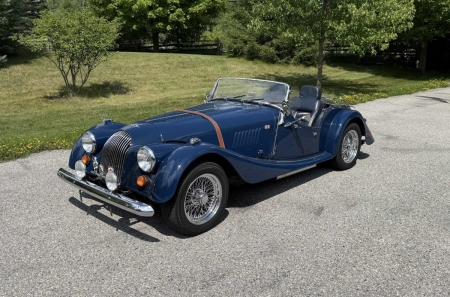
Hi, Has anyone any experience of fitting wire wheels on an early 90's Plus 8? I've seen a conversion from Motor Wheel Services for a 15 inch rim with hub adaptors and wonder what people think. Tyres are 205/60 15. The wheels look fine on the car but I wonder what difference the weight of the hub has on the car. The hubs supposedly make the wheel protrude 1 1/4 inch each side but to be honest they look fine. Thanks for your help. Watty (new member) 
|
|
|
|
|
Joined: Aug 2010
Posts: 534 Likes: 1
Talk Morgan Regular
|
|
Talk Morgan Regular
Joined: Aug 2010
Posts: 534 Likes: 1 |
Hi Watty, I've not done the conversion myself but i understand that the stainless wire wheels are very heavy compared to the cast bolt on wheels.
They will probably have a detrimental effect on steering and handling if that's the case and so it would be good to hear from people that have had this done.
|
|
|
|
|
Joined: Aug 2006
Posts: 7,935 Likes: 133
Talk Morgan Guru
|
|
Talk Morgan Guru
Joined: Aug 2006
Posts: 7,935 Likes: 133 |
Welcome Watty.
Are you looking to fit the wire wheels because you prefer the look?
In terms of what heavier wheels do, the increase the unsprung weight on the axle.
This synopsis covers the effects of unsprung weight:-
(it is quoted by someone who hasn't noted the original source, so is therefore quoted without original reference)
"The sprung weight of a wheel controls a trade-off between a wheel's bump-following ability and its vibration isolation. Bumps and surface imperfections in the road cause tire compression--which induces a force on the unsprung weight. In time, the unsprung weight then responds to this force with movement of its own. The amount of movement is inversely proportional to the weight - a lighter wheel which readily moves in response to road bumps will have more grip when tracking over an imperfect road. For this reason, lighter wheels are often sought for high-performance applications. In contrast, a heavier wheel which moves less will not absorb as much vibration; the irregularities of the road surface will transfer to the cabin through the geometry of the suspension and hence ride quality is deteriorated.
Pneumatic or elastic tires help by providing some springing for most of the (otherwise) unsprung mass, but the damping that can be included in the tires is limited by considerations of fuel economy and overheating. The shock absorbers, if any, damp the spring motion also and must be less stiff than would optimally damp the wheel bounce. So the wheels execute some vibrations after each bump before coming to rest. On dirt roads and perhaps on some softly paved roads, these motions form small bumps, known as washboarding or "corduroy" because they resemble smaller versions of the bumps in roads made of logs. These cause sustained wheel bounce in subsequent vehicles, enlarging the bumps.
High unsprung weight also exacerbates wheel control under hard acceleration or braking. If the vehicle does not have adequate wheel location in the vertical plane (such as a rear-wheel drive car with Hotchkiss drive, a live axle supported by simple leaf springs), vertical forces exerted by acceleration or hard braking combined with high unsprung mass can lead to severe wheel hop, compromising traction and steering control.
Though this is usually not considered important, at least in the popular literature, there is a positive effect. High frequency road irregularities, such as the gravel in an asphalt or concrete road surface, are isolated from the body more completely because the tires and springs act as separate filter stages, with the unsprung weight tending to uncouple them. This can improve overall safety. "
|
|
|
|
|
Joined: Jun 2011
Posts: 39
Just Getting Started
|
|
OP
Just Getting Started
Joined: Jun 2011
Posts: 39 |
Many thanks for the responses.
The car in question is one I am considering buying but someone I respect in the Morgan world was a little concerned about the conversion. It takes away the originality from the car and could harm its drivability. The wheels are painted and are not stainless - do S/S weigh more? I have driven it and it seemed fine to me though. I know wires weigh more than alloys and it was this plus the hub weight that was causing me concern. I know Morgan, around 1993, offered a wire option on a new car, but this was on 16 inch rims, but not sure how wide. This though did not need an additional hub kit so seems a more thought through application. Would have cost a lot more though.
From what Simon has said, there are gains and losses in increasing the unsprung weight of the wheel - I presume Morgan are well aware of the pitfalls but it has not stopped them fitting these type of wheels to its cars right up to the present day. I doubt as well they uprate bearings etc. to account for the increased pressures exerted.
The wheels really suit the look of the car, but I would have been happy if it had kept the alloys as well.
On reflection, I feel the conversion has probably harmed the value of the car a lttle, rather than enhanced it. But I suppose any car which is nearly 20 years old will differ slightly from its original spec to suit its numerous owners over its life.
Need to think a bit more before making a commitment. I intend to keep the car a long time and don't want to make a mistake in rushing to buy.
Watty
|
|
|
|
|
Joined: Dec 2008
Posts: 22,371 Likes: 354
Roadster Guru Member of the Inner Circle
|
|
Roadster Guru Member of the Inner Circle
Joined: Dec 2008
Posts: 22,371 Likes: 354 |
Watty It's a reversible change so don't agonise about it. I wanted wires and don't care a hoot about the effect on the road. Others prefer alloys - that's the way of the world. So if you like this car and that's the only problem - you know what to do next....... 
DaveW
'05 Red Roadster S1
'16 Yellow (Not the only) Narrow AR GDI Plus 4
|
|
|
|
|
Joined: Aug 2006
Posts: 7,935 Likes: 133
Talk Morgan Guru
|
|
Talk Morgan Guru
Joined: Aug 2006
Posts: 7,935 Likes: 133 |
Watty, Morgans tend to get modified by their owners; therefore, I wouldn't be too concerned about the switch to wire wheels from that perspective. Also, as Dave has said, it isn't irreversible.
Wire wheels are heavier than the other Morgan offerings but that doesn't mean the car in question hasn't been set up to handle the extra weight. If you are serious about it, what about getting it looked over by a knowledgeable mechanic (preferably one with Morgan experience)? This should help put your mind at rest.
|
|
|
|
|