|
Forums39
Topics49,847
Posts837,387
Members9,596
| |
Most Online1,063
Jun 14th, 2026
|
|
|
There are no members with birthdays on this day. |
|
|
|
Joined: Jul 2007
Posts: 27,809 Likes: 749
Member of the Inner Circle
|

Member of the Inner Circle
Joined: Jul 2007
Posts: 27,809 Likes: 749 |
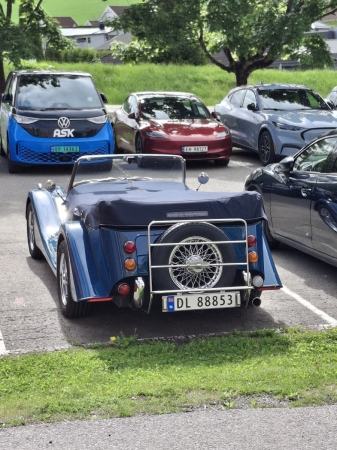
There is no dual fuel. Only Propane or Gasoline. The propane tank is where the normal gasoline tank would go. The spare does fit higher on the Propane car as the wooden bracketry is removed and the spare wheel mounts directly to the propane tank.
I have converted a good number of US (Bill Fink) propane cars to Gasoline. Both Plus 8s and 4/4s. Not all that difficult. The hardest part is creating the wooden bracketry for the spare wheel.
Cheers,
Mark I meant only the car ran on both but not at the same time. My boss had a Volvo converted. You could switch fuels via a switch on the dash as you drove. The ISIS Mogs I understood were only lpg to meet the California emissions regs
JohnV6
2022 CX Plus Four
2025 Renault Scenic Alpine etech "Yvette"
|
|
|
|
|
Joined: Feb 2011
Posts: 1,500 Likes: 2
Talk Morgan Enthusiast
|
|
Talk Morgan Enthusiast
Joined: Feb 2011
Posts: 1,500 Likes: 2 |
Well, we never had a dual fuel set up in the US. But never found a need. My 4/4 ran propane for some 80K miles before I converted it.
Cheers,
Mark
Mark
1934 SS MX4
1938 Series 1 DHC
1951 Plus 4
2005 Roadster
|
|
|
|
|
Joined: Nov 2018
Posts: 6,667 Likes: 433
Talk Morgan Sage
|
|
Talk Morgan Sage
Joined: Nov 2018
Posts: 6,667 Likes: 433 |
Mine had the button thing on the dash - start using petrol then switch to gas, run on gas until it ran out and then switch to petrol - there were a couple of quick stages in between where you had to purge one type of fuel before switching to the other, but it wasn't onerous.
The main reason for needing dual fuel in the UK was the limited LPG coverage and range issues. Sounds familiar!
"Y mae dafad ddu ym mhob praidd"
1972 4/4, 1981 MGBGT, 1984 FLHT1340, 1980 XLH1000, 1990 ZX10
|
|
|
|
|
Joined: Sep 2016
Posts: 1,463 Likes: 98
Has a lot to Say!
|
|
Has a lot to Say!
Joined: Sep 2016
Posts: 1,463 Likes: 98 |
I converted two cars to LPG back in the 90s. The Land Rover 90 was very straightforward as it ran on carbs so a fully manual setup was installed, just needed a saucepan size vapouriser plumbing into the cooling system located in the engine bay and a mixer plate between the carb and the inlet manifold. Few switches and solenoids, the tank and piping and it was in and working. Installation took about a day and then I paid to have it certified, all in the cost was around £300. Swapping the Landie for a Range Rover (injected) I wanted that converting too so I found a kit with two ‘torpedo’ tanks under the sills. The EFI needed to be tricked into thinking there was fuel pressure in the petrol injectors so a cheat box was needed but that also had the benefit of starting the engine on petrol and then you had a choice of switch over conditions based on either time or revs, I chose to switch to gas at 1700rpm. Total install was around £800. Both installations broke even within a year and gave no problems although searching for LPG was a bit of a faff.
Last edited by Grumpy2; 26/03/24 08:50 AM.
2012 Plus 4 in Sport Green. Much comfier than the Plus 8!
|
|
|
|
|
Joined: Jun 2022
Posts: 1,045 Likes: 148
Has a lot to Say!
|

Has a lot to Say!
Joined: Jun 2022
Posts: 1,045 Likes: 148 |
I converted my TVR Chimaera to dual fuel, that is I could run on petrol or LPG and selected at a flick of a switch.
Like the Morgan Plus 8 a TVR Chimaera also runs the Rover V8 which is an engine that works extremely well on LPG, however, I assume your Plus 8 runs the Lucas 14CUX & a distributor which means you'll need to use an older technology LPG piggyback ECU. Be aware the system will just be manipulating your petrol injector durations and running the outputs through its peak and hold injector drivers, the piggyback does nothing with the ignition side which is a shame as LPG is 110 Ron, for this reason and others I'll get to later you really want to be running a lot more ignition advance on LPG to get the best from the fuel.
LPG also has a calorific value that's at least 18% lower the petrol by volume, so be sure to design your tank system to carry 18% more LPG than it held in petrol or you will suffer a reduction in range, this could become a significant frustration as LPG stations are quite scarce these days and with many people switching to electric most fuel stations are pulling out their LPG pumps and replacing them with EV charging points.
The voluminous nature of LPG in its gaseous state also displaces air in the combustion chamber, the net result of this and the lower calorific value of the fuel inevitably means a loss in engine performance, especially if you can't take advantage of the higher octane level by running a lot more ignition advance. I solved the range issue by stacking two tanks one on top on the other that combined carried 18% more LPG than the original petrol tank capacity, I then put an auxiliary petrol tank on top to give me a 300 mile range on gas and a very practical 120 miles on petrol, but all this was only really possible because a TVR Chimaera has an uncharacteristically large boot for a sports car.
To solve the ignition advance challenge I fitted a trigger wheel on the crank, removed the distributor, and replaced it with a Canems Dual Fuel stand alone engine management system that also replaced the aged Lucas 14CUX fuel only ECU. The Canems Dual Fuel system not only gave me 3D mappable control over both my saturated petrol injectors but separately the peak and hold LPG injectors too, it also meant when toggling between fuels I could run two unique ignition tables to suit the octane levels and burn speed characteristics of each fuel type. LPG burns slower but more completely than atomised petrol so you end up with more complete combustion running on gas, but you do need to light the fire earlier to get the best from it so it's not just the higher octane of LPG that demands more ignition advance.
The system worked well but I found to get the best from the LPG side a gas temp & pressure sensor was needed. I actually used a combined map and air temp sensor from Bosch that you'd typically find on a Turbo charged petrol Vauxhall Astra/Vectra. Instead of measuring boost and air temp post compressor I used the sensor to measure gas pressure and temperature post vaporiser and pre LPG injectors, it's important to understand LPG changes in volume quite dramatically over a very small temperature range which has a big impact on your air fuel ratios (AFR). Likewise variances in pressure have a similar effect and no matter how good your vaporiser is there will always be pressure fluctuations, so with the ECU now taking gas temp and pressure input data from that clever dual sensor from Bosch two correction tables were added to the Canems software that allowed me to map out the variations in AFR. To finish the job I replaced the old Lucas narrow band lambda sensor with a far superior Bosch LSU 4.2 wideband sensor, this allowed me to run closed loop, I then built a target lambda table and let the ECU make the final trims to nail my AFRs.
In the end I was able to get my 4.0 Litre TVR Chimaera making 250hp and 270 lbs/ft of torque on LPG and delivering the petrol cost eqivalent of 45 mpg, the car would get to 60mph in 5 seconds flat and romp on to a sat nav confirmed 153 mph max speed all while making glorious V8 noises. With an LPG touring range of 300 miles and 120 miles of petrol on board to get me out of trouble it ended up being an incredibly practical performance GT that delivered old school driving thrills and proved to be the perfect vehicle for touring continental Europe where LPG is far easier to find than it is here in the UK.
Last edited by Montegue; 26/03/24 03:12 PM.
|
|
|
|
|
Joined: Jun 2022
Posts: 1,045 Likes: 148
Has a lot to Say!
|
|
Has a lot to Say!
Joined: Jun 2022
Posts: 1,045 Likes: 148 |
Here are some photos of my conversion. ![[Linked Image]](https://i.ibb.co/XChmVXh/Boot-Space.jpg) ![[Linked Image]](https://i.ibb.co/0DVrtVT/Boot-Space-2.jpg) ![[Linked Image]](https://i.ibb.co/fYvSd1h/Filling-Up-in-Holland.jpg) ![[Linked Image]](https://i.ibb.co/SdTxT3L/Filling-Up-With-GPL-2.jpg) ![[Linked Image]](https://i.ibb.co/wc8q6Fj/Filling-Up-With-GPL.jpg) ![[Linked Image]](https://i.ibb.co/9WBsNFY/Gas-Pressure-Correction.jpg) ![[Linked Image]](https://i.ibb.co/GtTdB01/Magic-Power-3-vaporizer.jpg) ![[Linked Image]](https://i.ibb.co/xshKND8/Spinner-Filter.jpg) ![[Linked Image]](https://i.ibb.co/VNnhty7/Yeti-Injectors.jpg) A good vaporiser, LPG injectors and the very latest technology filtration system to protect them all is essential, LPG contains a waxy substance known as 'heavy ends' which can cause havoc so this must be carefully managed. You will also need a strong and healthy ignition system as LPG is harder to strike than petrol, the heavy ends can also cause plug fouling which in turn will overstress your HT leads causing them to fail dramatically and inevitably misfires will follow. I ran MSD wasted spark Ford type coil packs, MSD HT leads and controversially NGK BPR5ES which is quite a hot plug, but the No5s self cleaned brilliantly which in turn took a lot of load off the HT leads. Once I'd fully developed the system it gave outstanding reliability, drivability, performance and obviously fuel economy, LPG is also a very low carbon fuel. Don't get me wrong, LPG is still a hydrocarbon but it only contains three carbon atoms which almost half that of petrol and a third of dirty diesel, this not only means lower emissions but less engine wear and greatly extended service periods as the engine oil stays golden for thousands and thousands of miles. Unfortunately LPG is no longer a very practical option here in the UK, as previously stated in the last 4 years so many LPG pumps have been removed in favor of electric charge points the availability of Autogas has become a real issue. What a shame 
Last edited by Montegue; 26/03/24 03:07 PM.
|
|
|
|
|
Joined: Mar 2024
Posts: 29
Just Getting Started
|
|
OP
Just Getting Started
Joined: Mar 2024
Posts: 29 |
I've researched it. it is not that financially profitable. At 2000 km per year and a saving of approx. 0.8 €/L and about10L consumption, that's a saving of €160 per year. Opposite this is the LPG system, a gas tank and a small petrol tank. Even if you install it yourself it's 3000.- (in germany you needs a separate tank for the cold start phase with petrol.)
It will then pay for itself in 50 years if you spend 100.- every 2 years for gas testing/maintenance.
:-( you would have to drive 10,000 km for it to work.
greetings riri
Last edited by riri; 29/03/24 04:44 PM.
Greatings from germany, +8 1997 3,9 l blue
|
|
|
|
|