I have an Aero Barnstomer Jacket, they also make RAF sheepskin jackets, beautifully warm, very heavy leather. Slightly less conspicuous than a flying jacket and can be worn more often as a result when not accompanied by the Spitfire.
https://www.aeroleatherclothing.com...za--blackened-brown--46----s-7062/s-7062 ‘The Barnstormer’, a non-military-issued style born in the early days of aviation that’s synonymous with daredevil pilots in post-war America.The-Barnstormer-Jacket-Modern-Barnstormers-made-by-Himel-Bros.-and-Aero-Leathers-)
The jacket known as a Barnstormer is a mid-to-long length leather jacket with four external pockets, a belt at the waist, adjustable cuffs, and a large shawl collar that sometimes has a shearling covering. Traditionally made from horsehide, Barnstormers feature two angled slash pockets at the chest, two large flap pockets at the hip, and often a double-button closure for a customizable fit.
History of the Barnstormer Jacket
The Early Years of Aviation
While the golden age of aviation was between 1920-1939, World War I (1914-1918) saw the first significant military use of airplanes, just 11 years after the airplane had been invented by the Wright Brothers in 1903. Planes such as the American DH-4 Liberty plane and British Sopwith Camel and Bristol F-2 took to the skies and played a major part in the war and taking part in the first dogfights and major bombings.
Similar to open cart travel on the ground, Pilots in WWI needed a longer jacket to protect their bodies from the frigid temperatures in the sky. This led to earlier flight jackets, such as the British RFC Jacket, being a full-length leather coat, fitted with an asymmetric button placket to make room for a large map pocket, as well as a belted waist and large collar to protect the neck. With the American Aviation Clothing Board not being founded until 1917 (one year before the end of WWI), the British RFC Coat became the iconic flight jacket of the WWI allied forces.
Birth of Barnstorming
More importantly, WWI bred a population of pilots that were highly skilled in something that civilians could only dream of doing — flying. These young men had endured an intense and exciting initiation to the aviation world and were looking for ways they could make a living off of their skills back home in the States. Craving the rush of flight once more, some of these pilots purchased leftover stock of the iconic USAF training airplane — the Curtiss ‘Jenny’ JN4 — and began the daring, aerobatic practice that would go on to be named ‘Barnstorming’.
Adopting a nomadic lifestyle, the Barnstorming pilots set up flying circuses in the Early 1920s, landing their planes in the fields of small towns and setting up spontaneous airshows. Spectators would marvel as the pilots performed incredible and dangerous aerobatic stunts like loops, rolls, dives, and even wing-walking. The aerialists would also attempt to fly through barn doors and burst out of the back (not always successfully), a highlight of the circus show that birthed the moniker “Barnstormer”.
Not all of the Barnstormers were former Air Force Pilots, though. It would disrespectful to not mention one of the first female aviators and iconic Barnstormer, Neta Snook Southern. After training with the Curtis-Wright Aviation School, Snook defied the patriarchy to obtain her pilot’s license in 1920, after purchasing and rebuilding a wrecked Canuck (the Canadian version of the aforementioned Curtiss ‘Jenny’ JN4). Snook used her Canuck to Barnstorm throughout the Midwest and eventually California.
Katherine Cheung (1904-2003) was the first woman of Chinese descent to earn a pilot’s license. Although she became active in flying after the Banrstorming era, she was a key figure in the golden era of aviation and an icon amongst female pilots. She is pictured here in a Barntstormer-style jacket in the 1930s.
Barnstorming continued until the late-1920s to early-1930s, whereby newly passed safety restrictions made the spectacle too difficult to carry out profitably, causing it to fade away.
While there isn’t a specific jacket worn by all of the Barnstormers, early Barnstormers bought double-breasted leather sportswear Mackinaw/car coats that were long enough to protect them from the cold temperatures in the air. It is generally accepted that these styles were an Americanized adaptation of the aforementioned full-length RFC Flight Jacket. Aero Leathers reflects on this:
“Inspiration for the coat we now know as “The Barnstormer” came from Royal Flying Corp’s full-length leather flying coat, manufactured by companies such as Burberrys and Gamages.
As became the general rule, American leather companies developed the idea to produce a better, more serviceable and easier to wear version. The American versions first appeared in the Sears catalogues of the 1920s and 1930s. The flying leather necks, the cropdusters, the cargo and mail pilots of the 1930’s all faced long hauls in bitter weather conditions with only their flying coats to keep the elements at bay.
Their first choice was a Double Breasted Horsehide leather coat, chosen for its warmth, strength and durability…the same hallmarks that are found in the Aero Barnstormer. Although never an “issue” item, many US manufacturers produced virtually identical versions right through to the late 1930s, using horsehide exterior while the linings varied from the heavy horse blanket material to the more luxurious, lighter weight yet warmer, alpaca wool imported from Peru.” – Aero Leathers
Aero Leathers has played an instrumental part in the barnstormer story, as they were the first maker to produce a leather jacket in this style and actually name it The Barnstormer in their 1986 collection. Prior to that, it would have just been referred to as a car coat or early flight jacket. Aero Leathers remains one of the most prominent makers of the iconic Barnstormer style to this day.


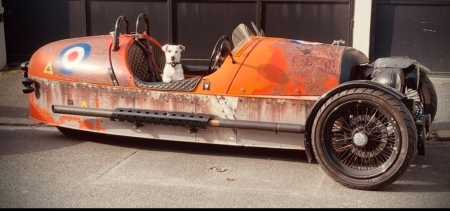


 Note to self, buy flying jacket....