Can you log your Omex 200 ignition, what coil arrangement are running and at what dwell? At what rpm do you get the missfire, you need to make sure your coil setup is able to refresh fast enough? If the Omex 200 doesn't offer a scope feature and a logging function I'd be looking to scope the ignition under load on the rollers using a PicoScope, or even a good old Sun Tuner machine as this is the only definitive way to diagnose ignition based hesitation or misfires that do not appear at idle.
Under load, cylinder pressure increases, requiring higher voltage to jump the plug gap which exposes weaknesses in coils, HT leads, and plugs. Our old Champion plug tester had a coil, an airline fitting, and a pressure gauge for this reason. You'd plug it into the workshop compressor, slowly open the valve while watching the plug and pressure gauge, then record the pressure at which point the spark went out. Keep in mind peak cylinder pressure is where peak torque is arrives, peak torque and peak cylinder pressure under load are intrinsically linked.
If you've had the car on the dyno and you've recorded where peak torque arrives, you also know where your peak cylinder pressures occur. If the missfire appears at or arround the engine speed under full load where you found peak torque, it's a strong idication something on the ignition side is falling over.
However, you also need to elimiate a rich or lean missfire from your list of suspects, a lambda sensor is your best friend here. I'd also want to put a fuel pressure gauge in the car to prove/disprove your fuel pump is genuinely maintaining a solid supply to your carbs under full load, and at high rpm. Remember, the actual shape of the spark burn line on your scope reflects the chemical composition inside the combustion chamber.
A PicoScope, a lambda sensor and a fuel pressure gauge should be all you need to find your issue. As with all diagnostics, one piece of evidence is never sufficient, you need at least two, and prefferably three pieces of corroborating evidence that all point to the same suspect.
Can you log your Omex 200 ignition, what coil arrangement are running and at what dwell? At what rpm do you get the missfire, you need to make sure your coil setup is able to refresh fast enough? If the Omex 200 doesn't offer a scope feature and a logging function I'd be looking to scope the ignition under load on the rollers using a PicoScope, or even a good old Sun Tuner machine as this is the only definitive way to diagnose ignition based hesitation or misfires that do not appear at idle.
Under load, cylinder pressure increases, requiring higher voltage to jump the plug gap which exposes weaknesses in coils, HT leads, and plugs. Our old Champion plug tester had a coil, an airline fitting, and a pressure gauge for this reason. You'd plug it into the workshop compressor, slowly open the valve while watching the plug and pressure gauge, then record the pressure at which point the spark went out. Keep in mind peak cylinder pressure is where peak torque is arrives, peak torque and peak cylinder pressure under load are intrinsically linked.
If you've had the car on the dyno and you've recorded where peak torque arrives, you also know where your peak cylinder pressures occur. If the missfire appears at or arround the engine speed under full load where you found peak torque, it's a strong idication something on the ignition side is falling over.
However, you also need to elimiate a rich or lean missfire from your list of suspects, a lambda sensor is your best friend here. I'd also want to put a fuel pressure gauge in the car to prove/disprove your fuel pump is genuinely maintaining a solid supply to your carbs under full load, and at high rpm. Remember, the actual shape of the spark burn line on your scope reflects the chemical composition inside the combustion chamber.
A PicoScope, a lambda sensor and a fuel pressure gauge should be all you need to find your issue. As with all diagnostics, one piece of evidence is never sufficient, you need at least two, and prefferably three pieces of corroborating evidence that all point to the same suspect.
Good luck with it
Ha! Your mind went where mine did… got to be an ignition timing issue. Coil pack failure or TPS packing up giving the ECU the wrong load signal so spark is in the wrong place.
I replaced the coil pack, TPS and got live data from the ECU… all good. Still have the fault!!
Two sets of spark plugs, a new coil, TPS and Laptop ECU cable later……. What’s your Next move?
Ha! Your mind went where mine did… got to be an ignition timing issue. Coil pack failure or TPS packing up giving the ECU the wrong load signal so spark is in the wrong place.
I replaced the coil pack, TPS and got live data from the ECU… all good. Still have the fault!!
Two sets of spark plugs, a new coil, TPS and Laptop ECU cable later……. What’s your Next move?
My next step would be to stop the 'Parts Darts' apprach, and scope it
Be systematic, and follow a logical diagnilostic path.
If you have access to good old fashioned Sun or Krypton tuner machine they still work as well as they always did, but they're only as good as the operator and much of the skills have been lost, a PicoScope is the moden equivalent of those big old tuner machines in a far more conveniently sized form factor.
If you're systematic, you avoid skipping steps, and resist the temptation to make assumptions.... you will inevitably find the issue
Looking back, it's a crying shame we all threw those Krypton/Sun machines away
Saying that, things have moved on massivley, a devise that was once as big as your tool chest is now no bigger than a paperback book plus your laptop.
This is worth a watch.
However, if you're considering investing in a scope I'd put the cash into moving on from the Omex 200 and carbs. I fully accept it's easy to spend someone else's money, but if you have the available funds to fit an EMU Black ECU from ECU Masters and replace the Webbers with a set of Jenvey Heritage ITBs, you'll never look back.
For roughly £3k all in you'll sudenly have infinite control over your fueling and ignition, a live real time window into your combustion chambers via a modern, acurate and super fast responding Bosch LSU 4.9 wide band lambda sensor, knock sensing, oil and fuel pressure inputs with customisable failsafe strategies plus a sophistcated two step rev limiter and much much more. Everything is now fully integrated within one of the most intuative pieces of engine management software you'll ever use, a software suite that also gives you invaluable data logging and even an onboard oscilloscope feature.
You already have the inlet manifold for the Jenvey Heritage ITBs, the ECU would be completly hidden so the new setup would look absolutely identical to your current arrangement. Which looks the absolute nuts by the way, especially with the wonderful BDA look-a-like cam cover, I've been following your race prep with interest and respect, you are clearly a maticulous kind of guy who likes to get things right while working in a well equiped and super clean environment.
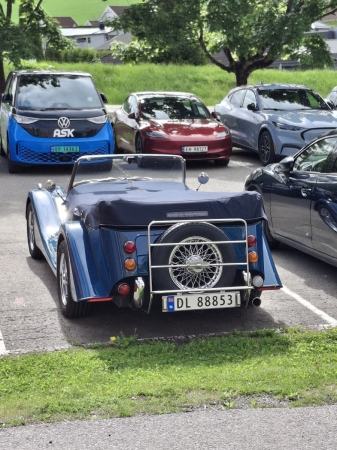
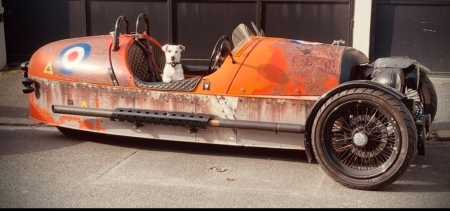
Your Morgan is also forensically clean, so for someone smart like yourself who has very high standards, I'm in no doubt you'd absulutely love tuning with an EMU Black, given you're also a racer the data logging alone will for sure be a total game changer.
Saying all that, you're probably going to tell me the regs say you must run carbs?
Monty, many thanks for the heads up on the many and varied types of digital interrogation equipment that can measure and monitor and in a shorter period of time than any human brain....
Which is just great when it all works.
On the other hand such is the degree of digitisation built into modern vehicles that some can spend inordinate lengths of time, or making repeat journeys to official dealerships with recurring faults that seem to elude those challenged with resolving them... Give me a set of carbs and points, and chances are that I can fix it at the side of the road..... as I have managed in the past.... But then I am nought but an old selective Luddite inclined to rant on a bit on occasion... (-:
I’m lucky and able to live in both your worlds…. The two 4/4 race cars I have are twins other than one (Blue and White) has Jenvey ITB’s and the Other (Yellow and Grey) has carbs.
They were designed to run in different classes…. as a novice to circuit racing entering in a more conservative fashion I felt was wise ahead of going straight for the Blue and White car which is power aligned to Class 2.
Going this route may also provide a relatively tame on-ramp for my eldest son in a few years as no doubt he will want in on the action.
When the fix is revealed in a few weeks - you’ll be kicking yourself!





![[Linked Image]](https://www.talkmorgan.com/gallery/27/full/42483.jpg)


