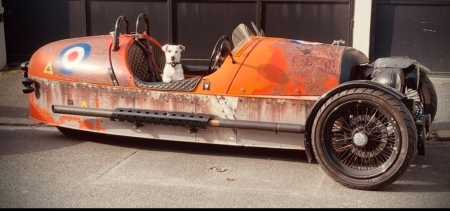
Yes I too agree with this advice, I have messed about jacking them for years and find the rear cross member plenty strong enough on a car of your years age. You can jack easily using the diff as well. It's an Australian pick-up trucks diff/axle so plenty strong enough. If you want to use the rear cross member, it's the one that sits forward of the spare wheel mount, you'll see three little 2BA bolts hanging down....... It's not the one right at the back of the car. Oh no! that's wood! Depending on what you want to do under there you can place the axle stands under the axle tubes or the cross member forward of the rear wheels as Deejay said.
If you wish to place the whole car on axle stands then this is how I would do it .
Start at the back as we've just covered, chock the front wheels first! If you're going straight in with the jack you will need a low entry racing type jack with a reasonable reach or you can jack both side evenly using the forward cross member with small jacks to gain access height for a standard trolly jack at the back. When happy fit axle stands to either the axle tubes or forward cross member.
Now the front, again here the crosshead on your car is plenty strong enough. You will see the central section has a big X shaped strengthener. Place the jack centrally right under the axle tube under the centre of the X. Jack the car up to your desired height then position the axle stands under the lower axle tube, one each side just outside the central square on the wheel side, say leaving a few inches from the weld. I use 6 ton axle stands as they have greater stability and better height option. This makes the car impressively safe to work on and under.
If you are ever using a lift then the jacking pads remain the same for the rear ie. the forward chassis cross member but the front is at a point on the chassis legs. If you open a bonnet and at the bulk head look straight down at the chassis you will see a triangular fillet pointing forward. it strengthens the crossmember to chassis joint. There's one each side and you place the jacking points under these straddling the chassis rail and the Webb fillet..... hope that's all clear!
Now here's a problem. It.'s not advisable to jack one side of the car up or just one wheel either. The front is fairly simple, centrally under the crosshead and raise both wheels. The Back a little difficult. If it's possible under the axle by the wheel and just enough to clear the wheel from the ground, if not, the forward cross member will have to be your choice of placing. I made a jack base support which fits into the tool tray where a first aid kit is designed to go This increases stability by incorporating a couple of steel dowels to locate the jack to it, again just enough lift though to clear the ground. I presume you have centre-lock wheels. loosen before jacking! And perhaps I may be as bold as to say, it's a good idea to check the tightness of these say every few hundred miles..... not because they will fall off, no in fact the opposite as they tighten in use and if you ever have the misfortune to need to change a wheel out in the wild you don't want to find you can't undo the blessed thing.. I have made and carry, fitted to the car; an extended spanner for this purpose as I don't want to be on the moors in driving rain at night and can't get the wheel off! But then again as per Sod's Law it won't matter what you have made provision for it'll always be something you hadn't planned for! So RAC membership in the toolbox is a good idea!
God all these words to say something so simple! However we're here, rear leaf spring lubrication, Well the collective have explained access most eloquently. These leaf springs can actually make or break your pleasure time with a Morgan. They have very limited travel and need to work properly. Firstly, with the car on the ground or better still with the rear jacked up and on axle stands under the axle tubes. liberally spray the leaves of the springs with penetrating oil, next ... make a cup of tea and enjoy! After about 20 minutes using the spare wheel or it's mount bounce the car up and down many times. you will see the red rusty muck come pouring out. repeat and repeat. If you can treat and bounce over a couple of days that would be even better. You will see the red rust start to clear. Let it dry overnight if you can then, and this is what I have found best. start using a light engine oil, go sparingly as its hard to get it into the leaf interfaces... paint brush and tin is the best. Then back to the bounce oil repeat! You'll know when you've hit the jack pot. Now finish with some grease applied again with a paint brush just sparingly. This catches any of the turbulently present grit that flies around under the car and allows you to easily wipe it down before re-servicing the springs the next time. NOW go drive the car this will be the best thing you have done to it so far. It will also allow you to assess your car and how loaded etc. it is. To further finesse it adjustable shocks might need sourcing or adjusting if you already have them fitted. Lastly, There is a member who posts on here under the name Rog. He makes suspension assisters that are as easy as lego to fit and their improvement to the rear end is beyond remarkable. Save £150 of Britains finest and buy a set! Of everything I have done to my car these and BRB's.... brake reaction bars, are the two most remarkable upgrades I would not be without!
To those here who know all this... well I apologise, to those who don't.... this is an important parable!
Best of luck and remember this is fun...... enjoy Ray!
|