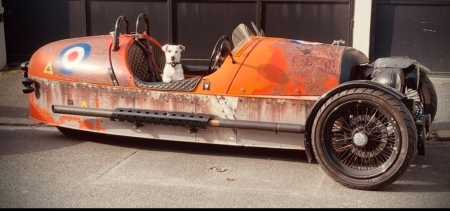
So what’s wrong with Morgan suspension anyway?
Before you all rush off to get funny springs and wobbly wishbones please consider the following. Apologies it’s a bit long
First the positive bit. Theoretically Morgan suspension design is as near as perfect, short of anti gravity, you can get. Two important points. The track remains pretty well consistent throughout the suspension travel and is certainly better than wishbone suspension where the radiusing effect of the arms has to be compensated by flexing of the tire sidewall. Secondly it has potentially the lowest unsprung weight of any suspension system since the only thing that moves is the wheel and the stub axel assembly. Something important in a light car where the ratio of sprung to unsprung weight determines how well the wheels stay stuck to the road. It also has an elegant elemental simplicity about it. It says what it does and how it does it and this philosophy explains why the car is the way that it is. So how come in reality it performs as badly as it does?
First lets define badly. Tootling along a gently undulating road is fine. Hitting anything like a pothole, or worse still a patch of seriously unlevel road the impression is that the suspension has a temporary nervous breakdown. Do it on a hard corner it is disquieting to the extent that what you gain in performance and general roadholding you loose because of the not unreasonably fear that the suspension will suddenly stop doing what it is supposed to be doing. Its quaint, entertaining and I suppose only mildly dangerous but it does beg the question why? And I don’t think this has anything to do with the legendary hardness of the suspension or inadequate shock absorbers. So is this something inherent to the design and is their anything more that could be done to improve it?
One obvious observation is that there is absolutely no compliance built into the system. By this I mean things like the rubber bushing found on the inboard end of suspension links, which provide some sort of insulation to the mechanical components from sudden shocks. In the Morgan everything is metal on metal so perhaps it is not surprising that the impression is that under certain conditions the suspension appears to momentarily freeze. So is this really what is happening and if so why? If the suspension bushes were evenly loaded nothing would be a problem, but of course they are not. As with any kingpin the fact that the wheel is offset creates a strong angular load on the bushes which is not too much of a problem for a joint that only has to turn, but is perhaps a more serious problem where the thing has to slide up and down as well. And to visualize what I think might be happening we have to imagine a Morgan suspension with a single badly fitting bush. The stub axel assembly with the wheel in contact with the road is being twisted relative to the fixed kingpin so in our single badly fitting bush it is apparent that the entire load of the car is bearing on the outside top corner and the inside bottom corner of the bush. A situation that would clearly jamb as what should be a load distributed over the face of the bush is actually bearing on a very small surface represented by the corners of the bush thus creating very high frictional forces. Think about the crude ratcheting arrangement on the plunger of your grease gun or a cheap mastic gun. One might reason that if the bushes were a good fit, that their were two bushes a reasonable distance apart as they are and lubricated with copious quantities of thick grease this effect would be fairly minimal and the system would work, which of course it does. However this jamming effect is always to a small degree going to be there and crucially the friction is going to be greater or lesser according to what the car is actually doing. Subject to a sharp shock the first response of the suspension is for the increased angular load to cause the bushes to dig into the pillar, potentially breaking down the grease film and increasing the friction. One would also have to reason that the sideways frictional forces on the bushes must vary quite dramatically when subject to inertia loads when breaking or cornering. For example in heavy cornering the inertia forces on the outside wheel at some point balance out the angular forces supporting the car thus dramatically reducing the friction. But on the inside wheel the frictional forces are proportionally increased. And this perhaps explains why the performance of the suspension varies quite dramatically according to road conditions and the lateral loads to which it is subjected. And this is not good. In practice this means is you can’t confidently drive the thing to its limits because you are never entirely sure what those limits are. The best you can say is that they are variable. And variable can also mean unpredictable. Or as Top Gear put it; you point the thing into a corner and see what happens. So is their anything more that can be rung from this theoretically brilliant, but I would suggest fundamentally flawed system?
One could argue that these changes in frictional loading in response to varying lateral loads are inherent to any suspension system but are perhaps have a more significant effect in the Morgan design because of the larger diameter of the kingpin and the fact that the bushes have to do two things; that is both turn and slide. And this explains why lubrication is such a critical issue. My instinctive feeling is that the lack of compliance in the system may also be part of the problem. If for example the bushes were fitted in slightly flexible mountings, like a silentblock bush rather than pressed rigidly into the stub axel this might have the effect of cushioning them from sudden shocks, but perhaps more importantly keeping the bush naturally aligned with the axis of the kingpin so that the frictional forces are more evenly distributed across the entire face of the bush. However, regardless of whether or not this would have any useful effect the system obviously depends on very effective lubrication and the more effective it is the more it will mitigate, but not eliminate, the effects of these variable frictional forces. The total loss lubrication system. You pump in the grease and nature takes it out again is alright up to a point except that its performance depends on how enthusiastically and regularly it is serviced and there is of course the problem of having an grease sodden lump only inches from a brake disk which must never be contaminated. A design issue that you could claim was suicidally negligent.
The obvious solution; that is effective seals to the bushes to keep lubricant in and dirt out is I suspect in practice rather difficult to achieve. The problem being the grease. Grease lubricates by sticking to the surface of things and unlike oil isn’t very mobile. So to devise a seal which will hold the grease in means the seal has to wipe the grease off the surface of the kingpin and then replenishing it afterwards, which it clearly isn’t going to do. So in an ideal world the system should be lubricated with oil not grease. People who manufacture things like Mc Pherson struts or rams for earth movers don’t seem to find it too difficult to devise effective seals to keep fluids in and dirt out so you could safely assume that if the lubrication reservoir between the bushes was filled with oil rather than grease, effective oil seals should keep it largely where its supposed to be. So would oil mobile enough to be constantly wiped on and off the kingpin be heavy enough to provide effective lubrication of the bushes, given that we suspect the variable loadings are rather high? Probably not, otherwise someone would have tried it. Which leads to the fairly obvious conclusion that what the system really needs, and deserves, is its own independent pressurized lubrication system.
Relatively thin oil is pressurized by a small hydraulic pump and fed down a hollow kingpin exiting through cross drillings into the stub axel lubrication reservoir between the bushes. Its forced under pressure past the bushes and collected in a chamber between the bush and oil seal and returned at low pressure via a flexible pipe to a remote reservoir that feeds the pump. Which sounds complicated, but given the fact that the lubrication system is now virtually maintenance free and in conjunction with modern oil seals and hard chrome kingpins ought to last as long as any other competitive system. Doesn’t involve the re design of any major components, could probably be reto fitted and ought to work. Or at least guarantee that the system was working as well as it can to mitigate issues that I have argued are inherent to the design. Crucially the handling ought to be more consistent and the advantages of the system; constant geometry and low unsprung weight can be properly exploited. Anything else is down to spring rates and damping which is a question of application or personal preference.
And yes. If it doesn’t have Morgan suspension I’m afraid it isn’t a Morgan