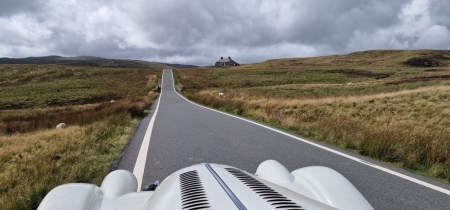
Last year I had the idle and running of the car (1960 +4 with TR3 engine) dialed in perfectly and she purred like a champ, and have adjusted the SUs many times on the car and feel confident futzing around with them.
Since last year I have replaced the interior, brakes, parts of the gearbox, and had the engine completely serviced and 83mm liners replaced with 87mm liners. After the engine work, the shop ran the engine on their stand with their shop carbs and it did well. I have since put the stock SU H6 carbs (SM needles) back on and am running into difficulties. When I first turned the engine over, fuel poured out of the front float bowl overflow pipe onto the wing. I cleaned out the float bowl valve and now it's doing well. I also disassembled and cleaned both carbs, even thought about polishing them. Installed new rubber/cork gaskets in both. Both carbs do have some degree of throttle shaft play and this will be something to address in the near future (they were doing fine when the car was last run). The front carb was leaking some petrol around the jet bearing, but after an overnight soak in oil to renew the gaskets it is no longer leaking.
When the car is running at idle and warmed up it is super-d-duper lean judging from the exhaust color, pulse, smell, piston-lifting-pin causing rough idle and RPM to fall, and the temperature creeps up quickly. While running, I sprayed all over the carbs and linkage with carb-cleaner but found no evidence of a vacuum leak (I expected to). When I place a carbsynch tool over either carb, the idle speed increases substantially. The question remains though - why is this sucker so lean?! Should I have to replace needles when bumping up the displacement? If so that's awesome and an easy fix.
Another think I noticed when cleaning out the carbs is that mud-daubers had built nests in the passageways that connect the area above the carb piston to the outside air (the two small holes on the face of the carb). Not sure if this could have been 'naturally' enrichening the mixture and now that I've removed the mud they are running lean.
Any suggestions as to where to go next from here?
As an interesting aside. Mud daubers really do like to plug up tubes and cause problems, I'm unsure if you guys in Europe or OZ ever have to deal with them:
Involvement in Florida Commuter Airlines accident[edit]
On September 12, 1980, Florida Commuter Airlines flight 65 crashed en route to Freeport, Bahamas killing all 34 passengers and crew. The cause was determined to be due in part to a malfunctioning air speed indicator caused by mud dauber nests that were improperly cleared from the aircraft's pitot tubes.
Involvement in Birgenair Flight 301 accident[edit]
On February 6, 1996, Birgenair Flight 301, a 757 jet flying from Puerto Plata in the Dominican Republic, crashed into the Atlantic Ocean. All 13 crew members and 176 passengers were killed. A key part of the accident was a blocked pitot tube, a component which measures outside air pressure through small tubes on the outside of the aircraft and displays this as the plane's speed. Although the tubes were never recovered from the ocean floor, it was discovered that the plane had been sitting on the tarmac for almost 3 weeks with the pitot tubes not covered as they should have been. Investigators believe a colony of black and yellow mud daubers got into the tube and built their cylindrical nests inside, causing faulty air speed readings which were a large part of the crash. This species also brought down another plane in Washington during 1982.