Interesting subject thermostats Heinz. Not all of a particular advertised temperature work the same. The opening range is equally important. I was given an "80°C" thermostat to cure overheating on a vintage marine diesel engine, replacing the previous 72°C one. It worked because the high temperature one actually started opening at 65°C. I suspect a new thermostat alone would cure your issue Heinz although admit a lot of thought, sourcing and experimentation would be needed. This would allow full use of your larger capacity radiator, possibly required in extreme circumstances.
Note after 2006 MMC fitted the same radiator to all Classics so the cooling system didn't have the benefit of custom tuning of system that Ford would have made to each of its cars.
That's certainly worth considering, Richard. Because as it is now I can not really take advantage of the benefit of the larger radiator, for example, in a traffic jam in the hot summer or I have to change the area of the cover of the radiator more often, so less in summer, more in autumn and winter.
Your thought seems very conclusive to me. Already on the standard Ford, yes, the thermostat is an 82 degree (from memory) type so the engine reaches about 88 to 90 degrees. On a conventional cooling circuit with a thermostat before the radiator intake, it would be an 89 degree thermostat to keep the engine at 89 degrees.
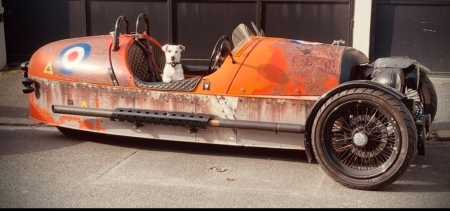
But in my case, without the radiator cover I might have to install a type with a characteristic that might open as early as 75 degrees (as an example) but then also stay closed until, say, 82 degrees. And I agree, all possible Ford engines, from the 1.6 to the 3.0 had the same radiator in the Morgan which is not the Ford philosophy.
Maybe for fun I'll install a 77 degree type or similar if I can find a thermostat that fits the Ford mechanically. Another difference to the conventional circuit is that when the thermostat opens, the cold water flows through the direction of travel and not the hot water...and that the thermostat must react to the mixing ratios of the temperatures it feels from both sides....quasi a temperature mixing sum must move it to open