I think the effects of road salt will initially be more cosmetic on aluminium but this in itself is a form of corrosion. You would need a less porous stainless chassis to be confident of use on our winter roads. Engine block and alternator housing show up the surface corrosion on aluminium as soon as the first winter of use with white flecks. Land Rover developed an aluminum sheet variant they called Birmabright early in production which if my near 60 year old example is anything to go by survives well. No idea what MMC use. Galvanic corrosion near dissimilar metal fittings can be another issue probably increased by salt.
In Canada, where we have long winters (or used to), road salt used to be used liberally, too liberally. We found that salt merely turns plowed snow into ice..or worse and a concentrate of salt water is held against the car metal constantly. 30-40 years ago we could not expect a vehicle NOT to begin rusting after 2 years. It was a plague and kept getting worse as the metal manufacturers used became ever more cheap and tinny.
The nation switched to using sand on the roads with only enough salt to prevent the waiting sand from freezing into a huge rock lump. ALSO, our governments, after negotiation and scientific input, passed laws making auto manufacturers selling in Canada warrant their cars against different levels of rust for different time periods. For example, no perforation permitted prior to 10 years. That ended the plague. Ergo, for some time now, manufacturers have been able to produce automobiles that can resist corrosion. It merely means the UK government has not acted on it (yet).
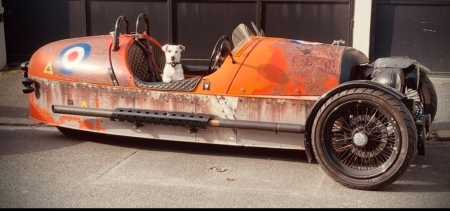
My MMC-made special Plus 8, with which I had to fight like hell to force them NOT TO UNDERCOAT with the inexplicable goo they used to use (do they still use it on the CX cars?), is
absolutely rustless for 21 years and counting. Which proves something I guess. Whether he meant it or not, Charles Morgan was right in declaring Morgans made for the life of the owner. Merely takes a dollop of owner input to assure that.
The re-created car arrived in January of 2003, leaving me months to change all the fittings to those (there were Morgan kits available) that would not cause the traditional galvanic reaction and I bought whatever was not in the kits from specials. On the discrete advice of, at that time, the Morgan Development and Compliance Director, which matched other experts, I treated every drilled hole that had been made in the wings or galvanized chassis (thereby breaching the galvanization and turning it to something that spreads rust rather than prevents it.) Other than that, I merely covered the underwing over spray with a thin impact protection. [i]My wings are Superform, but they were painted differently than they did the stock cars (under UK regs) back then.I still worried about them for a while, but they have not exhibited a single anomaly.

The only downside is that non-rusting, upgraded fittings will loosen, as they do not have the nature's "loctite" that rust provides. I became an expert in determining what method to employ to prevent loosening with non-rusting metal. (wryly)
gmg