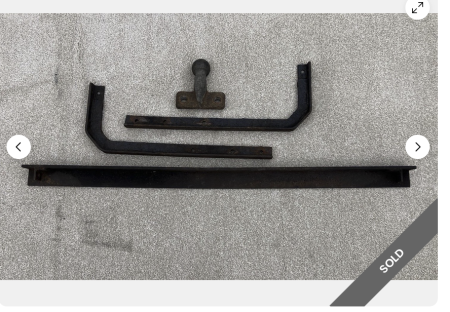
This consisted of a bespoke air deflector fitted within top of cowl, angled upwards to take cool air from well in front of rad and over the top, as suggested by Cain at Wolf Performance.A broad collector located as high as possible behind and slightly behind rad and attached to 4 inch hose hose picked up this cool flow and fed it to air box, mitigating the heat convection/conduction from rad top tank. Important since he had the now common larger aluminum rad limiting space above.
Hi Gentlemen,
I have become a big fan of Cain. He is now one of gomog's three recommendations for all-rounders to deal with trad-wise.
What you are imaging is what the legendary Rob Wells refers to as a "splitter". Diverting a bit of air over the rad into the engine bay and forcing a lot beck into the rad. Rob's wind tunnel tests shows that the odd canting of the trad rads, from the Factory until the plastic rad era and continued, inexplicably, by the aftermarket even after that. Makes no sense and I am saddened to see the Chinese alu rads, wonderfully inexpensive, have sadly copied it as well..leaving us with 200 quid alloy rads that are still less-than-ideal. Even the MMC, not those for changing old ideas, smartened up after they consulted, though their inexpensive plastic rads never thrilled me.[/i]
I am attaching Rob's sketch to me?Taken in an wind tunnel...the designer's wind analogue to a rolling road. BTW, I made a mistake 22 years ago when I used a wind dam rather than Rob's type splitter. The result lowered my coolant temperatures and melted every bit of plastic in the engine bay of that one of my cars...looked like something from Andy Warhol.

The affair you are showing is wonderfully made but cuts off air from the rad somewhat. A no-no. Splitting it is wiser and easier.
Developing a viable and improved cold air intake has been on the agenda for some time. No drilling into, cutting or irreversibly modifying existing components on the car was a prime consideration. Consequently if the mods were of no discernible benefit, all items could be removed and the intake returned to standard.
GREAT. The least invasive as possible is the best rule I have found. The rule I set for myself (which is not sacrosanct...I merely realized that my playing field would be unlimited and less fun if there were no boundaries) is, DO NOT DO ANYTHING THAT CANNOT BE REVERSED, BY YOURSELF INSIDE OF 24 HOURS. Of course, as I kept learning, that rule delineated a larger playing field. After years at my goals changed to making my Morgan simpler, more reliable and more susceptible to easy repair. It is a function of my type of usage
At speed, a strong flow of cool air enters the cowl grill and this was the favored entry point.
Forgive me the following but, with respect, it is an odd intake placement to find cool air, even at speed. You have placed it abutting and behind the VERY hottest point, namely BEHIND and at the hot top of the radiator. As old f*rt racers will tell you, the coolest flow is below and often slightly forward of the rad as air is its coolest down, not high up low. However, if high up is needed, the German dealers Mertz and Pabst, once very into racing, designed the one I attach below. It is made with carbon fiber, far less likely to heat. You could divert the entry lower or do not have it abut the rad and be forward of it.
Another thing to note about the Morgan engine (and other) engine bays and intakes, that most of us ignore. The change of intake shape and their hoses muchly change torque. I had heard about that in my readings and conversations but I was surprised at how true it was. So much so, that John Eales, with his in-shop flywheel dyno, designed his own bespoke intake, for his large crowd of Morgan race cars. Frankly, I stopped early on. My goals were different from yours and Montegue's. I had designed a car that went over my bhp plans, so the niceties of airflow gave way to secondary considerations of Morgan aesthetics. As long as I did not produce induction noise and it was pretty, I was ok with it. I was still over the bhp I wanted. I accordingly used different air intake system depending on the Morgan. The dyno taught me some common Morgan mistakes but these apply to pre 2004 Plus 8s and pre-2000 Plus 4s.
A large touring plaque had previously been tied to the cowl front without adverse heating effects,
I should mention that your standard canting of the radiator is unhelpful, though standard for pre-plastic rads and aftermarket rads. Habit is a more potent determinant of everything than logic is. Once an error passes into tradition....
It can be costlessly mitigated. ![[Linked Image]](https://www.tm-img.com/images/2024/01/05/IMG_4975.png)
Wonderful execution!!!
![[Linked Image]](https://www.tm-img.com/images/2024/01/05/IMG_5047.png)
Currently waiting for the weather to cheer up before road testing and a track day at the end of February should deliver a verdict on these mods.
I have found that only fiddling and trying things on a rolling road is worthwhile. But I am REALLY enjoying the attitude and adventures you and Montegue are having. Bravo!

Forgive me if I have misunderstood your images.
gmg
Rob Wells Air Splitter (1999)![[Linked Image]](http://www.gomog.com/TEMP/RobWellsAirSplitter.jpg) Mertz&Pabst Air Intake Over the Rad Version.
Mertz&Pabst Air Intake Over the Rad Version. ![[Linked Image]](http://www.gomog.com/TEMP/Mertz&Pabst8airintake1.jpg)