For fear of stating the obvious, as swing shackles are an essential component part of any leaf sprung suspension system, and on a traditionally chassis Morgan we have rear mounted swing shackles, when the rear suspensions is under compression a Morgan axle not only rises, as the leaf spring flattens and so lengthens it also must also be allowed to roll backwards with the shackles.
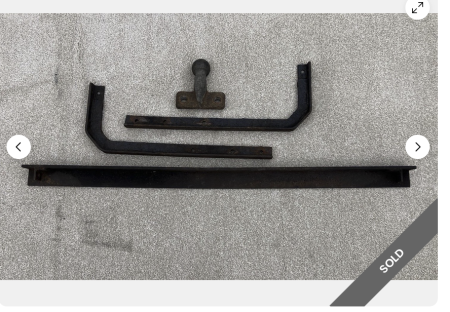
If you fit a rigid bar tying the axle directly to the chassis, the axle can no longer roll back, the anti-tramp bar used by Morgan is just this, it is also therefore no different to removing the rear spring shackle and replacing it with a fixed pivot point on the chassis. Swing shackles exist for a reason, removing them or fitting a rigid bar tying the axle to the chassis (essentially the same thing) is to completely ignore the natural flattening and disregard the consequent lengthening of the leaf springs under compression.
In such a setup the poor leaf spring ceases to function as a spring, compression loads are now effectively moved along the spring length end to end, it will therefore largely function as a solid bar itself. Of course the Morgan ant-tramp bar is not strictly speaking fully rigid, while it does have pivots at both ends these should be ignored as they will have no effect on the compression and expansion loads placed on the bar as the axle attempts to roll back and forth, so the only reason the Morgan ant-tramp bar is not fully rigid is because it's been fitted with a big rubber bush.
It's quite clear all the compression and expansion loads on the bar will be directly transferred to the bush, as such it's astonishing the bush and or the chassis mounting point for the anti-tramp bar lasts longer than a few hundred miles! I would imagine what saves the system is the very short travel of the Morgan rear suspension, this in itself is a function of placing the rear axle over the flat chassis rather than the common solid axle design practice of placing the axle under the chassis that is also arch shaped at this point to allow for axle movement under compression.
For sure, if the Morgan axle could move any more than the very limited amount it does, the anti-tramp bar bush and or its chassis mounting point would have very short lives indeed.
To understand why Morgan chose to horribly limit the rear suspension travel by placing the axle above the flat chassis, we must travel back in time to the early 1930's when the 'Low Chassis' look became fashionable, by placing the axle over the chassis car makers such as Invicta (there were many others) could create a far lower and sleeker look.
![[Linked Image]](https://i.ibb.co/ffwrh8D/Invicta-S-Type-Low-Chassis.jpg)
Clearly Morgan/HFS were heavily influenced by the 'Low Chassis' fashion in the early 1930's when designing the 4/4.
![[Linked Image]](https://i.ibb.co/5gDBCX6b/HFS-in-an-Experimental-Chassis-Shortly-After-WWII-768x473.jpg)
However, in choosing to place the axle above the chassis, in a stroke HFS created the suspension travel and ground clearance issues that unbelievably we are still discussing on Talk Morgan today, some 90 years later!!!
Back to the Invicta S-Type Low Chassis, it's well documented that Donald Healey who raced the first of the breed was so concerned about the ground clearance of Noel Macklin's stylish under-slung design, that in preparation for the Rallye Monte-Carlo in the winter of 1931 he fitted larger wheels and higher cycle wings to give extra height over the snow-covered and deeply rutted roads.
![[Linked Image]](https://i.ibb.co/Nd0Qb06R/Classic-Sports-Car-Driving-Donald-Healey-s-Monte-winning-Invicta-Low-Chassis-121.jpg)
Almost comically, the issues that so concerned Donald back in 1930 as he prepared his Invicta for the 31 Rallye Monte-Carlo, still persist in the trad chassis Morgan community to this day. I myself have decided to fit 205/65 tyres to replace Monty's soon to be worn out 185/65 tyres, not for the extra grip but for the additional 12mm of ground clearance they'll give.
It's not my idea though, it was Donald's some 95 years before

Fitting lowering blocks to Monty revealed the need to raise the top mounts for my new Bilstein rear dampers by 35mm, this is necessary to regain the precious little travel lost in the process of lowering the car. TBH it would have been nice if the Morgan suspension specialist had mentioned this when I purchased the Bilsteins from him, but sadly that wasn't the case

However, I strongly suspect the chronically poor travel this gave me is the reason my tuned 183 horsepower Duratec Plus 4 currently doesn't exhibit any axle tramp whatsoever, this despite there being no ant-tramp bars fitted. With the rear end riding on the Bilstein's bump stops the axle is simply unable to move enough to reveal any wind up.
However, when I finally raise the top damper mounts by 35mm I fully expect axle tramp to rear it's ugly head

To fix it I will not be fitting anti-tramp bars for the reasons I've mentioned above, the way I plan to solve any axle tramp that may potentially reveal itself is to fit what the Yanks call a diff snubber. A diff snubber is simply a rubber cone fitted to my now strengthened rear hoop that will progressively and softly limit pinion angle, using a threaded rod and lock nut arrangement will allow me to set the clearance between the rubber cone and the pinion casing, I can then adjust and fine tune the snubber's effect on limiting pinion angle.
Well that's the plan Donald, God rest your sole