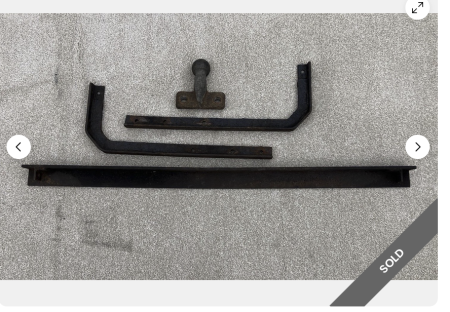
Goodness. That's an excellent desription of what's happening in engineering terms, thanks. I had drawn the same conclusion regarding the seemingly illogical and pointless ATB (especially just one), but having re-fitted it at least I'm not now tripping over it on the bathroom floor where I had stored it. I may de-mount it again next spring when I've covered some more miles, but next time I will get a ratchet ring-spanner as getting to that bolt from above (I don' t have a ramp) is a pain.
Staying in the history class room a little longer takes us to the release of the TR2 in 1953 where we saw the same axle over chassis setup.
![[Linked Image]](https://i.ibb.co/YTtHHFff/DSCF7082.jpg)
And for comparison here's a trad chassis:
![[Linked Image]](https://i.ibb.co/HTcQGJsF/Rear-Suspension.jpg)
As we can see it's the same setup, both are equally crude and prehistoric in their design, but I strongly suspect the TR chassis is more tortionally rigid than that of the Morgan. Anyone familiar with the TR2, 3, 3A and 4 will know the chassis/suspension had all the same issues suffered by us traditional chassis Morgan owners, so it's nothing new.
Triumph retained the same chassis right up to 1965 when the TR4A appeared, a run of some 12 years. By the late 1950's Triumph already knew they needed something better so in 1965 they released their solution, the coil sprung trailing arm setup that first appeared on the TR4A as shown below.
![[Linked Image]](https://i.ibb.co/JFFxWnCt/TR4-A-Reas-Suspension.jpg)
This arrangement persisted through the six cylinder TR range until 1976 when Triumph discontinued the TR6, the above system actually worked pretty well allowing as much as 150hp to be tamed without issue. Amazingly, Morgan ignored all this and continued with a setup that Triumph deemed outdated and redundant by the early 60's.
Morgan on the other hand decided the leaf spung axle over chassis arrangement was perfectly fine, and in 2012 they even considered it suitable for their near 300hp Roadster model. Clearly, it was a very long way off being up to the job of controlling such power and torque, realising this and instead of copying what Triumph had done some 50 years earlier to solve the exact same issues, they simply fitted a rigid anti-tramp bar without properly considering its true operation, then called that fixed

.
Morgan didn’t even fit two of the dreadful things, a choice that can only introduce some interesting twisting forces as one spring is effectively a solid rod, while the other does it's best to do what comes naturally