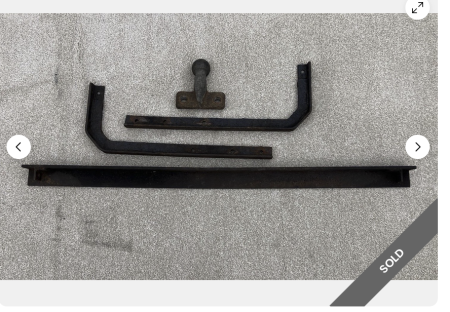
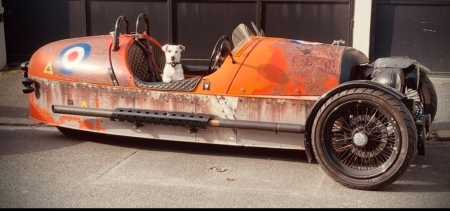
I think it's helpful to take a step back for a moment and accept what we're dealing with here is no more complicated than a telescopic damper conversion, back in the mid eighties replacing lever arm dampers with telescopic dampers was extremely commonplace, many different kits were offered for a host of classics running a beam axle, leaf springs and Armstrong lever arm dampers.
Some of these conversion kits were better than others, looking at Morgan's own attempt to replace lever arm with telescopic dampers we see an example of a poorly concieved and fundimentally flawed effort. Excessive damper inclination and the poor travel available imposed by the 1930's fashion of placing the axle above the outer chassis rails asside, in my humble opinion the more fundimental issue was to ignore the natural movement of the axle, it seems quite clear to me that Morgan fitted the damper eylets 90 degrees in conflict with how the suspension actually moves.
As the suspension on our cars compresses the leaf springs flatten and therefore lengthen, the swing shackles compensate by swinging backwards as is their job but as the axle is pinned to the leaf springs it must also swing backwards too. By fitting the damper eylets (the damper pivots) 90 degrees out Morgan created a system with some really horible twisting loads, these twisting forces result in premeture bush wear, snapped top bolts and broken bottom mounts that Morgan just kept making stronger and stronger untill they stopped breaking, this as oposed to properly studying the issue which soon would have revealed the error of their ways.
In its simplist form a telescopic damper is just a piston moving in a cylinder, for the piston to freely move unhindered up and down the parralel walls of the cylinder and avoid the dreaded and well known situation known as 'sticktion' where the piston can momentarily litrally stick in the cylinder, it's absolutely essential the rod is not subject to any side loads, for smooth operation a telescopic damper must be free to move with the natural movement of the axle or for sure you'll suffer 'stiction', at best the damper will function very poorly indeed and at worst things will simply start breaking!
Ironically it seems there was an earlier telescopic damper conversion kit for Morgans that actually got all this right from day one, the Rutherford kit put the damper eylets in the correct plain to allow the suspention to swing with the axle rather than fighting it at every compression and rebound event.
![[Linked Image]](https://i.ibb.co/chgfPqqN/IMG-20251202-WA0005.jpg)
Morgan for whatever reason chose to completely ignore the good work of Rutherford, and persisted with their school boy error geometry

Very soon I'll reveal the way I've chosen to fix the issue, it's really nothing complex, because nothing complex is required to fix such a simple mistake. All I've done is study all my component failures and used that evidence in combination with my simple study of how the suspention actually moves, the results being as blidingly clear as the solution.
In the mean time, here are some examples of the evididence I've gathered along the way:
![[Linked Image]](https://i.ibb.co/LdRsX4gL/IMG-20250410-WA0004.jpg)
![[Linked Image]](https://i.ibb.co/bMyfrXsS/IMG-20251123-WA0015.jpg)
![[Linked Image]](https://i.ibb.co/TqT8DTCq/IMG-20240906-WA0002.jpg)
![[Linked Image]](https://i.ibb.co/SXJmsLLp/IMG-20240907-WA0009.jpg)
![[Linked Image]](https://i.ibb.co/pBCDbKgT/IMG-20240907-WA0015.jpg)
![[Linked Image]](https://i.ibb.co/HTTfDS0C/IMG-20251123-WA0016.jpg)
![[Linked Image]](https://i.ibb.co/60ySYJLY/IMG-20240907-WA0006.jpg)
![[Linked Image]](https://i.ibb.co/4ntrJxjT/IMG-20251123-WA0013.jpg)
![[Linked Image]](https://i.ibb.co/NgqgX8vz/IMG-20251123-WA0014-1.jpg)
Quite litrally IT'S A SHOCKER