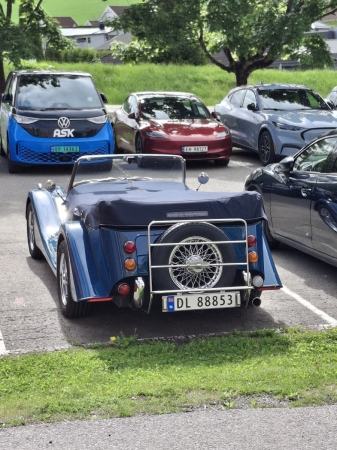
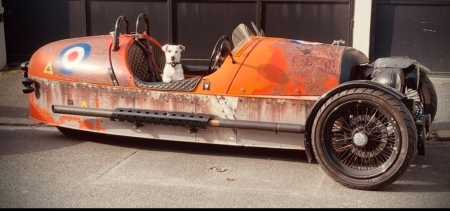
Monty - thank you very much for sharing this wonderful bit of advanced engineering with us it's beautiful stuff and extra grunt what's not to like.
Thanks Rich,
The objective here is really just to deliver a healthy lift in power while retaining Monty's excellent road manners and reliability, tuning naturally aspirated engines can be an expensive business so there’s no value for money logic to be found here, but I can share plenty of man-maths justification as this is precisely what I’ve been using to get myself to this very point

However, man-maths aside one thing is well accepted in the Duratec tuning world, if you’re looking to squeeze over 230hp out of a Duratec the weak point will for sure become the Ford factory con rods. Well, some may argue it’s more the rod bolts than the rods themselves but whatever the detail is things definitely start to become very expensive when you open an engine. I did very closely study the option oft fitting a low pressure Rotrex supercharger kit (8psi), but my research pointed strongly towards this placing Monty’s engine on borrowed time if I failed to take heed and fit those forged rods and pistons.
Ultimately all this set the brief and determined our target horsepower, with Monty already at 180hp and the super safe ceiling for a Duratec being 220hp, our horsepower goal would need to be somewhere between to two. The supercharger idea simply delivered too much power to be engine safe without spending a kings’ ransom, and I’m not so sure a 240hp Trad chassis Morgan is a good idea anyway!
Making power is actually pretty easy, the difficult bit is making good usable power while retaining a nice sensible idle and tame town manners, Monty needs to remain a pussycat on the road and to achieve this we've made what might be viewed by some as
'a couple of controversial choices'.
1.
Prioritising exhaust gas velocity and a meaningful anti-reversion lip over ultimate exhaust port size -
The thinking being is the ports on a Duratec head are already big enough to support 250hp, so with our lower target more than covered we've chosen to focus on porting strategies that will deliver superior torque.2.
Steadfastly refusing to take the obvious and well trodden ITB route in favour of retaining my Fusion Fabrications inlet manifold -
It's already acknowledged and widely accepted we could easily make more outright horsepower with ITB's, but for fear of repeating myself I’m after drivability and torque. As the brief focusses on delivering the desired driver experience over a making a specific horsepower number we can brag about in the pub; the long runners, single throttle body and idle air control valve offered by the FF inlet are all destined to remain.As we know, an internal combustion engine is just a giant air pump, the more air it can be made to shift the more fuel you can add in proportion to that air, with the outcome being more power. Of course, that mixture of air and fuel must still be at the correct ratio, and it must be lit precisely at the right time to ensure maximum cylinder pressure at the precise moment that pressure can also excert maximum leverage on the crank.
So, given all this the starting point for any tuning work is always to establish where the greatest restriction exists, address this restriction and you'll be making the greatest gains. To this end, I'm reliably informed by a number of highly respected Duratec engine builders (assuming your target is uder 250hp), by far the greatest restriction in a 2.0 Duratec cylinder head is not the already large enough and well-shaped ports, it's the valves.
If you then combine 1mm larger inlet and exhaust valves with some nice knife edging of the port dividers and clever reshaping of the 'valve bowl' which is the rounded, pocket-shaped area in the intake or exhaust port located directly behind the valve seat, the engine can really come alive. The 'valve bowl' is the critical transition zone where the air-fuel mixture passes from the port runner into the combustion chamber, after that it all becomes much more complex and a bit of a black art with good engine builders closely guarding their cylinder head porting strategies.
I can understand why too, as many spend years learning what does and doesn’t work, which can, and often does change significantly from engine to engine. I chose A.L Developments as Alan Prichard has been experimenting with, and developing the 2.0 Duratec head for decades now, I gave him my proposed cam specs, header tube dimensions and most importantly what I was looking for from the engine.
The rest is all locked up in Alan's head following years of amassed experience exclusively working heads, but with a special focus on the cylinder head found on four cylinder Duratec and Mazda L engines, this knowlege is what I paid for!