First of all, apologies to kankeL, he had PM'd me a couple of weeks ago looking for information about my catch tank. I managed to give him some info but couldn't get any photos due to family and other things going on that kind of got in the way till today. It's all been a bit busy of late.
Here's the photos;
Catch tank fitted to Rivnuts on the bulkhead. The black cases are the puncture repair bits and bobs and a battery booster pack, both bungied to ring bolts fitted to Rivnuts.
![[Linked Image]](https://www.tm-img.com/images/2020/02/12/M3W-Catch-Tank-1-of-7.jpg)
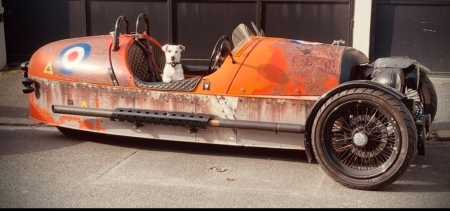
The filter fitted to the tank vent helps keep the oil mist in the tank, the vent plug supplied with the tank just let the mist out. (As an aside it's amazing how much bigger the M3W is than the 1930s originals

)
![[Linked Image]](https://www.tm-img.com/images/2020/02/12/M3W-Catch-Tank-2-of-7.jpg)
I used braided hose because I had some braided hose...bloody annoying stuff, if it touches anything it will wear through it, hence the bits of amalgamating and duct tape to protect everything else from it. The connector is a propane quick release, semi-dry break connector, makes it easier to take the tank off and drain it without getting oil everywhere while trying to work with the tank's drain plug.
![[Linked Image]](https://www.tm-img.com/images/2020/02/12/M3W-Catch-Tank-3-of-7.jpg)
The dry break also gives a bit of a labyrinth for the oil misty air to negotiate which helps to knock the mist down. The self sealing side is on the catch tank side of the connection for ease of handling the disconnected tank.
![[Linked Image]](https://www.tm-img.com/images/2020/02/12/M3W-Catch-Tank-4-of-7.jpg)
The connector disconnected.
![[Linked Image]](https://www.tm-img.com/images/2020/02/12/M3W-Catch-Tank-5-of-7.jpg)
The hose attachment in the Vee between the cylinders. I tapped this fitting to take a drilled cap head screw as a restrictor to avoid letting all the oily air out all at once.
![[Linked Image]](https://www.tm-img.com/images/2020/02/12/M3W-Catch-Tank-6-of-7.jpg)
Modification to the hose barb on the engine side of the connector; I also tapped this barb to take a filed down Allen cap head screw with a 1.5mm hole drilled lengthways through it.
![[Linked Image]](https://www.tm-img.com/images/2020/02/12/M3W-Catch-Tank-7-of-7.jpg)
Some more info;
The original vent from the crankcase into the inlet manifold has a restrictor at the manifold end. It is necessary.
Even with the restrictor at the crankcase hose fitting the pulses at the catch tank end are massive so a lot of oil mist gets through to the tank and out of its vent.
I filled the tank with some Explosafe foam that I had lying around, not to prevent explosions but to help knock down the oil mist. It helps.
The quick release connector itself helps knock down the oil mist and adding the drilled bolt as a restrictor helps too.
Before I fitted the tank I was getting a lot of oil drooling down the front of the engine from the air filter.
It is certainly possible that my engine has considerably more ring blow by than a shiny new engine, I've never taken the heads off to check the bores, or stuck a decent endoscope down inside for a look.
I will hazard a guess that a good deal of the oil that gets spat out of the crankcases is drain back from the tank into the (not particularly) dry sump. Having taken the photos today, I decided to drain the sump to see how much oil had accumulated in it since last running of the engine six weeks ago (I said I've been kind of busy!) Got over a litre of oil out of the sump and it was still trickling at a noticeable rate but the tub was getting a bit full so the plug went back in. I think in future I'm going to be draining the sump fairly often after even a relatively short lay-up - and tipping it straight back into the oil tank before firing up the engine.
If it sounds like more hassle to fit than expected, you'd be right. However, I'm not overly comfortable simply venting it straight to atmosphere; sometimes it can be a lot of oil and could also be a slug of oil which could be messy. I'm also not comfortable with venting it into the inlet manifold where it will either dribble down the front of the engine or go through the combustion chambers lowering the effective octane of the fuel in an air cooled engine that is at least a bit prone to detonation.
What would I change? I'd consider running the hose in a similar fashion to a slightly larger tank with internal baffle plates rather than the Explosafe. This would let me tip the collected oil back into the oil tank; I've lived in Aberdeen for a long time and have you seen the price of synthetic oil! Seriously though, on a long trip this could mean no need to carry spare oil as most of the oil lost from one tank ends up in the other one. If the vent from this baffled tank gets too oily I would run it to a second, smaller tank, probably with Explosafe and the vent filter just to keep things clean.