|
10 members (DaveW, Mats, Nick55, Luddite, Sir Percival, verysideways, +8Rich, 1560, SteveT, How),
324
guests, and
58
robots. |
|
Key:
Admin,
Global Mod,
Mod
|
|
Wales
by Joske Vermeule, September 1
|
|
|
|
|
|
|
|
|
|
|
Forums39
Topics49,863
Posts837,565
Members9,596
| |
Most Online1,063
Jun 14th, 2026
|
|
|
There are no members with birthdays on this day. |
|
|
|
Joined: Sep 2009
Posts: 7,435 Likes: 122
Talk Morgan Guru
|
OP

Talk Morgan Guru
Joined: Sep 2009
Posts: 7,435 Likes: 122 |
Here is an article in German that is quite clear and well written, so a Google translation should provide understandable results. It is not too scientific but also not too superficial in its description of what to look out for when measuring performance on the chassis dynamometer. Here is the link to the article https://www.auto-motor-und-sport.de/technik/die-technik-moderner-leistungspruefstaende/I noticed one sentence: „The terms wheel power and drag power always cause confusion: Many people see the measured wheel power and therefore believe that this is the power at the wheel, but this is wrong. Vehicle and test bench form a single unit: if you remove the car from the test bench, the losses and masses are also removed from the test bench. For this reason, the wheel power on the dyno is lower - therefore the drag power must be measured in order to add it up“ If I understand correctly, the measurement is carried out by first accelerating and then measuring the force of the motor. But it is not only the friction losses in the drive train etc. that are involved, i.e. "in the car", but also the inertia of the rollers with their electromagnetic resistances etc. is also measured. As soon as the maximum power or the highest speed is reached, the clutch is disengaged and the friction is measured during coasting. This amount is added at the end to determine a plausible power value at the wheel. If I understand correctly, the 58 hp drag on the 4/4 is not the same as the effective power at the wheel on the road, which is higher?
'14 4/4 graphite grey
|
|
|
|
|
Joined: Sep 2009
Posts: 7,435 Likes: 122
Talk Morgan Guru
|
|
OP
Talk Morgan Guru
Joined: Sep 2009
Posts: 7,435 Likes: 122 |
Montegue, I have copied this over here, maybe it will work, if not, no problem.
inally Posted by Heinz
Image, I don't know exactly, but I would assume that in my case something was added to indicate the crankshaft horsepower., otherwise my engine would generate 180PS at the crank shaft… If the manufacturer gives the power, e.g. 110 hp or similar for the Sigma 4/4 without tuning, is that crankshaft hp? which I would suspect.
Manufacturers always quote power at the crank, this is because they use engine dynos; at the time of recording the numbers there are no wheels wink
Engine dynos are where it's at because they give a true number the engine genuinely produces, the only reason we use a rolling road or a hub dyno is because it's inconvenient to remove the engine from a car just to record the engine's output, but of course people then try to work the numbers back to the crank because that's where manufacturer base numbers come from.
It should be quite straightforward to get a little ballerina 1.6 Sigma to make 100hp per litre, and in theory it should also make good power everywhere as it benefits from variable valve timing on both the inlet and exhaust camshaft, at 90kg that would be an excellent 1.78 horsepower per kilogram of engine mass.
But the elephant in the room for the plucky little Sigma is always going to be the 2.0 Duratec, in the same relatively modest state of tune as that tweaked 160hp Sigma, the Duratec romps away to deliver an easy 200hp, and without making a light car like a Trad Morgan nose heavy. The Duratec achieves this because you're only adding 10% more weight (10kg) to achieve a whopping 25% increase in power over the Sigma, that's the sort of deal you call a 'No-Brainer'!
Add more than 10% weight and I suspect that's where you'll start to feel the balance of the car change, don't get me wrong the Cyclone 3.7 V6 is an excellent engine but at 170kg it's 70% heavier than a 2.0 Duratec. I've been a V8 man all my life, but more recently I've found a new respect for the humble four banger, modern twin cam four cylinder engines are incredible things and as long as you don't go too far above 2.0 litres they are also super smooth allowing for very high engine speeds without vibration.
Most people will tell you 'King of the Hill' in the world of four bangers is the Honda K20, it's certainly an amazing engine that was right from day one but Honda just kept on developing it to make it even better, but what they don't tell you is, these Honda four banger 'K' series engines are quite heavy at 125kg
We think Monty's Duratec should be making 205hp, and at just 100kg that's an outstanding figure of 2.05 horsepower per kilogram of engine mass.
[Linked Image]
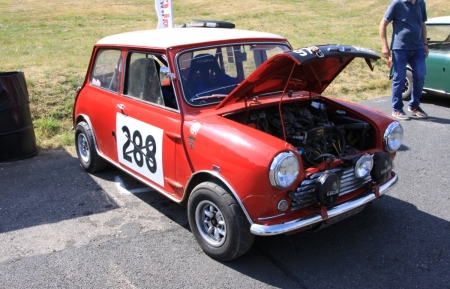
We also believe the Type-R K20 in my mate Dave's Z-Cars Mini 'Molly' pushes out 220hp from the 125kg lump, which is 1.76 horsepower per kilogram of engine mass, that's more or less the same as the Sigma.
You can just imagine the friendly 'Monty vs Molly' banter when the two Dave's get into down the pub somestick
Only last week I said..... "Ditch the washing machine Dave" laugh2
Merry Christmas to you all santarudy
Dave
I completely agree with you. The extra ten kilos is a crate of beer with 20 0.5 litre bottles, which is not insignificant. But on the other hand, it's relatively bearable if it's only 10% more weight. I'm actually thinking about something like this for my 4/4, a tuneable Duratec or I would look for a car like this and trade it in. However, I think your 4/4 will compensate for the balance with the 2.0 better than the flyweight of the 4/4 because of its slightly higher weight due to wider wings etc.
I also agree with you that the Honda engine is relatively heavy. I thought about the Honda for my Elise, but it's not worth the effort, even if the engine's own weight is less relevant if the car as a whole is still very light and if the engine is installed more centrally.
I think the Plus 4 with Duratec is a good combination with almost 200bhp. On the other hand...if I had the choice of a 2.0 with 200bhp in my 4/4 or sticking with 140bhp but with a 4.1 diff, I'd personally go for the shorter diff. Simply because the yshift points fit the road better.
'14 4/4 graphite grey
|
|
|
|
|
Joined: Oct 2019
Posts: 5,587 Likes: 603
Charter Member
|
|
Charter Member
Joined: Oct 2019
Posts: 5,587 Likes: 603 |
Interesting question Heinz .... I've had cause to use rolling roads a fair bit but you can overthink it ... I use the same dyno with the same operator (Damien at Daytuner in Ripley for my racer 🙂)... absolute accuracy against some benchmark? ... whether there's a tiny difference in drag between one gear in a box or the next? .... I've just been interested in the comparison between what I had and what I've got after a remap after some 'improvement' I've made .... just a comparison to see if what I did put more power to the road or less ... the graphs are also useful for deciding optimum shift points and setting shift lights (and where to set your rev limiter to not lose anyrhing useful).
I've never needed to look that closely at absolutes ... if, as you say, they just lump the drag of the dyno in with the drag of the car parts then that would go a long way to explaining the variation between different power runs on different dynos (though I assumed there would be some process for identifying the drag of a particular dyno over a period of time and factoring that out of the final graph??) ... glad I'm only interested in comparative figures from one given dyno/operator ... I suspect there's a big can of technical worms waiting to cloud the issue if it's absolutes we seek 🙂
K
Ps ... and that's before we get into the understandable Human desire for a shop who fits go faster goodies to give the punter a graph that makes them happy 🙂
|
|
1 member likes this:
Heinz |
|
|
|
|
Joined: Nov 2006
Posts: 921 Likes: 47
Talk Morgan Regular
|
|
Talk Morgan Regular
Joined: Nov 2006
Posts: 921 Likes: 47 |
Excellent cogent thread.
As stated by Image, dyno results are misunderstood for the reasons given. It should be noted, as well, that dynometers are also regularly checked and re-adjusted (or should be). So results, even on the same dyno can vary. Lastly, the "pub talk" crowd can't really fathom results. In fact, unless one is using one for a re-mapping, (as Mark Adams, the famous Tornado fellow) rolling roads (the only ones that our crowd should be using, are only vital for Morgans later made before 1990 (the end of the L-Jetronic era). One can only use them for minimal tweaking, like confirming the effect of air filters/intakes, or which gearboxes, differentials, etc or the extraneous stuff that you were not lead too far astray by aftermarketeers.
However, rolling road dynos are the ultimate TUNING devices for earlier generations, those of us running carburettors or L-Jetronic EFI or adjustable aftermarket EFIs. These automobiles have virtually and de facto, fuel maps and ignition timing that are tweakable with a flat head screw driver, a timing light, an exhaust analyzer and a fuel pressure regulator (with EFi). For THIS community, dynos are the very best way to tune a car, not simply for more power (if that is one's thing) but to one's preferred roads, driving style and reliability. I trot to the dyno shop, that has a capable operator I trust, along with the tools I need and whatever I want to try out.
One will often find that there is more fun and reliability at other than simply the maximum bhp one can achieve. Even manufacturers do not shoot for the latter. They want tuning that will cause the least warranty claims within government regs.
gmg
|
|
|
|
|
Joined: Jun 2022
Posts: 1,050 Likes: 151
Has a lot to Say!
|
|
Has a lot to Say!
Joined: Jun 2022
Posts: 1,050 Likes: 151 |
One will often find that there is more fun and reliability at other than simply the maximum bhp one can achieve. Even manufacturers do not shoot for the latter. They want tuning that will cause the least warranty claims within government regs. gmg A 2.0 Duratec four cylinder is by design a very strong and reliable engine with plenty of tuning potential left of the table by its designer, its well accepted you can tune it to 220hp without touching any internals, and still retain the well proven 200,000 mile Ford reliability and durability. Actually, it's the emissions targets that manufacturers are forced to meet that stops them realising the true power potential of their engines. For example, valve overlap is good for performance but bad for emissions, conversely catalytic converters are good for emissions but very restrictive. Manufacturers also tend to cheap out on exhaust and inlet manifold design, and again for emissions reasons they add further performance limiting features such as exhaust gas recirculation and swirl flaps. The 2.0 Duratec is such an easy and rewarding engine to tune because it was designed correctly in the first place, at just 100kg it's also very light for its potential output so offers excellent energy density, indeed if you study a Duratec in detail what you'll find is actually more akin to a competition engine which sits massively at odds with its dull Ford Focus, Mondeo, Mazda 6 origins. In our favor a rear wheel drive vehicle gives a lot more space to fit better exhaust and inlet manifold designs, if you also don't need to meet those emissions targets you're now free to realise the engine's true potential. When carefully curating the list of tuning components for my Duratec Plus 4 I simply looked at what was out there that's also proven to work well as a recipe, then copied it over to Monty. Tuning the 2.0 Duratec is such well trodden ground only a fool would try to reinvent the wheel, so the recipe I chose was really a function of plagiarism over innovation. 1. Replace the restrictive exhaust manifold with something better - I asked my fabricator to copy the excellent exhaust manifold used on the Plus 4 Superport, but also allowed him the creative freedom to improve upon it if he felt he could 2. Replace the Ford FWD plastic inlet manifold with something better - I asked my fabricator to build me an adapted version of his proven Fiesta ST150 manifold that looks a lot like it was inspired by the no longer available but legendary Mountune MR200 inlet manifold. The inlet manifold was just one part of a proven tuning package guaranteed by Mountune to release 200+ horsepower from the 2.0 Duratec. The kit worked so well even Ford themselves endorsed it, this meant after having Mountune fit their MR200 to your Fiesta ST150, Ford would continue to warranty the car 3. My new fabricated inlet manifold also meant we were able to completely remove the very restrictive swirl flaps, and the exhaust gas recirculation system - Actually anyone can make these two improvements to their existing plastic inlet for next to nothing, feeding an engine it's own exhaust gasses dulls throttle response and the swirl flaps are definitely a big restriction 4. Fit a better air filter arrangement - Probably on minor gains here but the Mondeo filter box does have a very small inlet port so does look rather restrictive to me, I went with an AEM DryFlow filter that seems to be working well enough so far 5. Replace the factory emissions based camshafts with something with more overlap, a little more lift and duration - Again I followed what everyone in the ST150 world seems to use, Newman Phase Two cams are the go-to option for any seeking a noticeable lift in performance while retaining daily drivability, I'd speculate the cams that came with Mountune's fabled MR200 kit would have been more or less identical to Newman Phase Two cam spec 6. Replace the factory valve springs with a set of 60lb beehive type valve springs - These were installed as a precaution against valve float that can occur at the higher engine speeds my Duratec is now capable of reaching Tuning is all about understanding that an internal combustion engine is really just an air pump, so the objective is simply to get it shifting more air. However, when you do that you will need to add more fuel to match all that extra air or you won't make any more power, indeed you may make less power and you will definitely be putting your engine in grave danger too because lean mixtures are the cause of many a catastrophic engine failure! As I fully predicted, at the end of my tuning journey I was left with a Duratec that was shifting so much more air the engine was now running dangerously lean, it also fell flat on its face if you dumped the throttle open or asked it to venture above just 3,000rpm. At this point it soon became clear neither the stock injectors or the Ford Mondeo Visteon ECU that controlled them were up to the job, so a set of Bosch Green Giant 440cc injectors we added and control of them was handed over the excellent EMU Black from ECU Masters. With some careful calibration work from yours truly my Duratec absolutely came alive, the difference in performance from the standard Plus 4 engine spec was nothing short of astonishing, never before have I tuned a naturally aspirated engine and seen such huge gains! But best of all is the car has not lost one bit of its super smooth and flexible drivability, indeed the engine is now noticeably more flexible than it was, finally I was astonished and delighted to discover that if driven in the same way Monty had retained his very frugal 38 mpg on a run. The car is way faster and nicer to drive with significantly crisper throttle response, yet when driven sensibly uses absolutely no more fuel than it did before I tuned it. The process delivered an win win with zero downsides, well I say no downsides, if the truth be known you never get something for nothing in this world. The one area where the engine will almost certainly have gone backwards is tailpipe emissions, forfeiting tailpipe emissions for performance is the payoff anyone considering tuning their Duratec must accept. Saying that, I opted for a 200 cell sports catalytic converter, aftermarket cats that will get you through the MoT are available or you could repurpose the Morgan original, but as I have a friendly tester this all seemed like further pointless restrictions to allowing the engine to breathe as the talented Duratec designer intended.
Last edited by Montegue; 07/12/23 03:35 PM.
|
|
|
|
|
Joined: Sep 2008
Posts: 1,398 Likes: 258
formerly known as Hugh Jorgan Has a lot to Say!
|
|
formerly known as Hugh Jorgan Has a lot to Say!
Joined: Sep 2008
Posts: 1,398 Likes: 258 |
Hi Montegue
I've followed your duratec tuning project with interest, as I'm sure many others have.
2 questions......
Does the finished version pass the emissions part of an MOT?
What was the total cost....??
|
|
|
|
|
Joined: Jun 2022
Posts: 1,050 Likes: 151
Has a lot to Say!
|
|
Has a lot to Say!
Joined: Jun 2022
Posts: 1,050 Likes: 151 |
Hi Montegue
I've followed your duratec tuning project with interest, as I'm sure many others have.
2 questions...... Q1 - Does the finished version pass the emissions part of an MOT?[ Not tried yet, but I doubt it, mind you the engine idles beautifully at stoich (14.7:1) so that's all fuel and oxygen burnt, any failure to pass an emissions test would therefore be down to cat performance. People worried about all this should simply ask their fabricator to repurpose their OEM cat when building the new exhaust, or simpler still, just find an MoT station with a sensible tester in residence  Q2 - What was the total cost....?? I believe I have covered this question before, but in truth it all really depends on how far you want to go? The big jump in cost comes when you need to map the car to get enough fuel into the engine to match the air, the sensible man wanting best value performance should probably just fit a better exhaust and an air filter then stop there, this should cost roughly anything from £1,200 for just the manifold to £2,000 if you also want the remainder of the system making up as I did. Just replacing the restrictive factory exhaust manifold should give a 20hp increase and take you to 165hp which the Visteon ECU and stock injectors will happily cope with. After that, and if you fit the Fusion Fabrications inlet manifold I used (around £1,000 fitted), you will now find the engine is shifting a lot more air, so much air in fact air it will also need more fuel to match or you 100% will run lean and the engine will feel very flat indeed. The standard injectors are actually perfectly up to the job of supporting the 185hp the engine is now capable of producing with both inlet and exhaust manifolds changed, all you need to do to hit that number is run a richer calibration in the Ford/Visteon ECU. Unfortunately this is where things get awkward, I couldn't find anyone up for properly live mapping the Visteon with the car on a rolling road. This MK3 Mondeo/2009 Focus engine management system is old now, and because it didn't appear on any cars that were even vaguely performance focused (no pun intended), mappers never really hacked it back in the day. These days the situation is even worse, OK so there are people out there who will play with fueling remotely, but first you've got to invest in the kit to reflash the ECU and I would suggest a wideband gauge kit is also essential, how else can you really be sure you're hitting safe AFRs under load? I'm not saying there's nobody out there who can live map the old Visteon, but even if you can find someone to do it, it'll likely be in the order of £600 for the session and if you then go on to add cams you'll be back with them again spending another £600 to get that setup mapped. You're now in the hole for £1,200 on mapping alone, this is where the plug and play EMU Black ECU at £1,150 starts to make a lot of sense. I knew I wasn't going to stop at an exhaust, I wanted the FF inlet and have previous experience with aftermarket ECUs so fitting the EMU Black made sense to me, once I had complete control over the engine management a set of Newman Phase Two cams were sure to follow. If you replicate my full house approach you're going to be spending £5,000 but this package should all add up to a 50hp increase taking the engine from 145hp to 205hp at a cost of £100 for every horsepower added. Not cheap I grant you, but spending £5k to turn a stock Duratec Plus 4 into a Supersport is still a useful £3k saving over buying a Supersport, you also get to develop the car in stages to spread the cost. But it's also why I started my response by saying the sensible man wanting the best value performance improvement from his Duratec should just fit a better exhaust manifold and stop there, if you can find someone to build you an Supersport replica exhaust manifold for £1,200 and you get them to keep the factory cat when they create it you'll have no emissions issues and achieve 165hp at a cost of £60 for every horsepower added. As I said, it all really depends on how far you want to go?
Last edited by Montegue; 07/12/23 09:36 PM.
|
|
|
|
|
Joined: Nov 2006
Posts: 921 Likes: 47
Talk Morgan Regular
|
|
Talk Morgan Regular
Joined: Nov 2006
Posts: 921 Likes: 47 |
As I said, it all really depends on how far you want to go? Fascinating posts. Thank you. gmg
Last edited by gomog; 08/12/23 10:08 AM.
|
|
|
|
|
Joined: Jun 2022
Posts: 1,050 Likes: 151
Has a lot to Say!
|
|
Has a lot to Say!
Joined: Jun 2022
Posts: 1,050 Likes: 151 |
As I said, it all really depends on how far you want to go? Fascinating posts. Thank you. gmg The challenge for anyone looking to tune a Plus 4 is not the Duratec engine, it's the Visteon ECU, this is frustrating because reaching 185hp should be as cheap and simple as following these three steps: 1. Have a good fabricator create a Supersport replica exhaust manifold that incorporates your factory cat - Estimated at £1,200 fitted 2. Fitting a Fusion Fabrications ST150 (Mountune MR200 replica) inlet manifold - £1,000 fitted 3. Reflashing the Visteon ECU with a suitable richer well developed calibration - Estimated at £300 I'm quite sure there would be a good market for such a package offered to Duratec Plus 4 owners at £2,500, for this sum you'll be taking the car from 145hp to 185hp which is a 28% increase in power so you'll definitely feel it, such a package would work out at a very reasonable £62.50 for every horsepower added. Ford Mondeo ECUs are also cheap so a reflashed version could be offered on an exchange basis to create a self fit kit, in the post you would get the exhaust manifold, the inlet manifold and the reflashed exchange ECU ready to plug in, and all for just £2,000. This self fit kit would bring the cost down to £50 for every horsepower added, which is about as cheap as naturally aspirated tuning gets. There must be someone out there with the software to hack the Visten ECU who also has a rolling road, all that's needed is a slightly richer calibration! Once the file has been created it can be replicated over and over for zero cost, so there’s actually quite a good profit margin in selling a 185hp self fit kit for around £2k and it’s cheap enough to stimulate quite a bit of demand too.
|
|
|
|
|
Joined: Nov 2006
Posts: 921 Likes: 47
Talk Morgan Regular
|
|
Talk Morgan Regular
Joined: Nov 2006
Posts: 921 Likes: 47 |
The challenge for anyone looking to tune a Plus 4 is not the Duratec engine, it's the Visteon ECU, this is frustrating because reaching 185hp should be as cheap.... Yes. Morgan engines are made for other vehicles..which are invariably much heavier. Re-configuring the engines is the only way to release their full potential in a Morgan. But not many have the urge to go that far, despite these being hobby cars. I went though the same process as you have, albeit with a different Morgan engine. And I decided on different goals. I came to the conclusion that the further I embraced closed technology, the less control I would have. And the farther I strayed from the Morgan template, support infrastructure and mates the less that suited me. But my preliminary conclusions match yours. However by Canadian law, my re-created Morgan was considered a classic beyond regulatory reach even before it was built! However, if I chose to, I could pass any emissions test of whatever year with a twist of a flat head screw driver. That was a characteristic of the decisions made. If you know your earlier fueling system, carb or EFI, you can do that..at least for the day of the test. (wryly) We agree that manufacturers and governments have different goals for cars than a hobbyist has. I very much like Ford's Visteon division. They are a brilliant automobile electronics company, one of the very best on the planet. I ran across them 22 years ago when I was looking for sound systems for our Morgans. (There are some long trips we mog to music and some we don't). At the time, they had a super powerful sound system they were putting in their high end product, Mustangs, Lincolns, even Corvettes (!)etc on both sides of the Atlantic. A radio/gps/stereo player that would hold up to 7 discs and take very little space, obviously dated now. It also came in a burl walnut finish that matched my Morgan dashes. When I had a wiring questions, the company would very willingly help me out. Have you considered contacting them? If you are doing so by email, send them a picture of your car. That always helps.  gmg ![[Linked Image]](http://www.gomog.com/TEMP/Visteon.jpg)
Last edited by gomog; 08/12/23 12:39 PM.
|
|
|
|
|