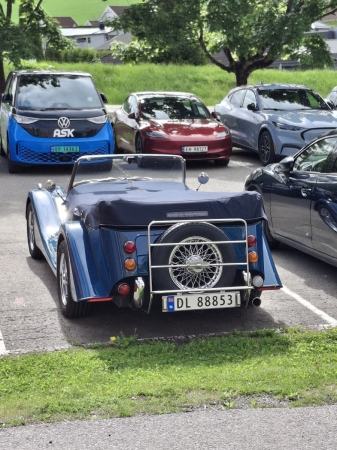
With apologies in advance for the length of this post (as a newbie I'm still learning the norms so I hope I haven't broken some kind of etiquette!).
I asked one of the advanced AI models (OpenAI's "Deep Research" product) to do a thorough analysis on the 5 and 10 year outlook for my particular car and market (a 2019 Plus 4, LHD, continental europe), taking into account things like demographic shifts, developments in consumer preferences generally, industry and regulatory dynamics, etc., using all available resources. The full report is copied below. As always with AI it should be taken with a rather big grain of salt due to "hallucination", sycophancy, etc., not to mention the inherently speculative nature of such an analysis, but I thought it might be mildly interesting to this group of Morgan experts. Please excuse the formatting as it didn't take well to the cut-and-paste:
Current Value and Market Context (2025)
The 2019 Morgan Plus 4 (110th Anniversary Edition) is already demonstrating the strong value retention typical of Morgan sports cars. When new in 2019, the Plus 4 110 Edition was priced around £44,000 in the UK, including about £8,700 of extras at no additional cost. secret-classics.com.
Today (mid-2025), well-kept examples with average mileage are selling in roughly the £35,000–£45,000 range, indicating only modest depreciation in six years. For instance, a 2019 Plus 4 110 Edition with ~9,000 miles (RHD) sold at auction in 2023 for £35,500 classic.com, which is about 20% below its new price – a shallow drop compared to most modern cars. In fact, Morgan has long been a low-depreciation marque; even 10–15-year-old Morgans often fetch close to their original prices on the used market pistonheads.com.
. PistonHeads’ buyer guide notes that used Morgans hold value strongly, with owners often seeing “strong value retention or even growth if you keep the miles down”
pistonheads.com
. This resilient value is partly due to Morgan’s limited production and enthusiast demand – there are never many for sale, so bargains are rare and sellers have little pressure to discount
pistonheads.com
. Another factor bolstering current values is the Plus 4’s special status as one of the last traditional Morgans. In 2020, Morgan ended production of its 84-year-old steel chassis design, switching to a modern aluminum platform for the new “Plus Four” model
motorauthority.com
. The 2019 Plus 4 (110th Anniv.) is among the final cars built on the classic ladder-frame chassis with ash wood framing – an architecture tracing its roots to the 1930s. Aside from a very limited 2020 Plus 4 70th Anniversary Edition (just 20 cars built to commemorate 70 years of the model
motorauthority.com
), the 2019 models represent the end of an era for Morgan’s old-school engineering. This “last of the traditional Morgans” cachet gives the car added collectability for enthusiasts who appreciate the vintage driving experience. The 110th Anniversary package itself, while not as rare as the Works Edition, adds desirability with its special badges and factory-fitted options (sport exhaust, mohair hood, performance seats, etc., which were included to celebrate the company’s milestone)
rmsothebys.com
rmsothebys.com
. All these factors mean the current market in Europe treats the 2019 Plus 4 110 Edition as a prized modern classic rather than a rapidly depreciating used car. Left-hand drive (LHD) specification further supports its value in the EU. Being LHD, this Plus 4 can readily be enjoyed or resold across continental Europe without conversion, widening the pool of potential buyers. Most Morgans were sold in the UK (RHD), but an LHD example is ideal for markets like Germany, France, the Netherlands, etc. – and European enthusiasts do value Morgans. Specialist dealers in the EU have listed 2019 Plus 4 110 Editions around €40K–€50K (depending on mileage and condition), reflecting healthy demand. Overall, as of 2025 the car’s value is holding steady at a high level relative to its new price, a testament to the Morgan Plus 4’s appeal as a niche collectible roadster.
Factors Influencing Future Value
Several key factors will influence the price trajectory of the 2019 Morgan Plus 4 110th Anniversary over the coming 5–10 years:
Limited Supply & Heritage – Morgans are hand-built in small numbers, and the 2019 Plus 4 was only produced for a short period (the 110th Anniversary was a one-year special). This inherent rarity will continue to support values. Additionally, its status as one of the last steel-chassis, classic-style Morgans gives it historic significance. Collectors often pay a premium for “end-of-line” models that mark the finale of a long-running design
motorauthority.com
. The craftsmanship and heritage of the Morgan brand (a family-owned British marque for over a century) also imbue the car with collectible cachet that more mass-produced sports cars lack.
Demographics & Collector Preferences – Shifts in who is collecting cars will impact demand. Generally, the interest in very old-school cars is waning as older enthusiasts age out, while younger collectors gravitate more to the vehicles of their own youth or to more modern “analog” classics from the 1980s–2000s
nasdaq.com
oraclefinance.co.uk
. A Morgan Plus 4 is a curious case: though built in 2019, its look and driving feel are throwbacks to the 1950s–60s British roadsters. This could mean that it appeals most to traditionalist enthusiasts, typically an older demographic who fondly remember classic Morgans and other vintage sports cars. As that demographic shrinks over time, demand for purely retro cars could soften. Industry data from 2024 shows exactly this generational effect: nearly half of the models in Hagerty’s classic index dropped in value, and the biggest declines were in 1960s-era cars, partly because fewer younger buyers are chasing those older models
oraclefinance.co.uk
. Meanwhile, the only category of cars that saw values rise were 2000s-era “modern classics”, as the generation that grew up with them is now financially able to buy their dream cars
oraclefinance.co.uk
. A 2019 Morgan Plus 4 straddles these trends – it’s a modern classic by model year, but with pre-1970s charm. If younger collectors view it as an outdated oddity (preferring, say, a 1990s sports car instead), its value might not spike. However, the Plus 4’s saving grace is that it offers a unique analog driving experience (open-top, manual gearbox, no electronic nannies) that could attract a subset of enthusiasts even in the future. Enthusiast media and experts note that many younger buyers are indeed shifting to “modern classics” and leaving “older, high-maintenance cars behind”
nasdaq.com
. The Plus 4 may benefit from being mechanically simpler and more reliable than a true 1960s classic (it has a modern Ford engine and Mazda gearbox), but its vintage persona will need to align with whatever nostalgia or curiosity the next wave of collectors has.
Evolving Consumer Preferences – Beyond age demographics, broader consumer taste is a factor. The coming generation of buyers, having been exposed to rapid advances in EVs and tech, might put a premium on classic cars that offer raw, mechanical driving pleasure as a contrast to ubiquitous electric appliances. In this sense, the Morgan’s timeless, analog appeal could actually become more cherished as such experiences become rare. On the flip side, preferences could swing toward modern performance and convenience, making a quirky, low-tech roadster a harder sell outside the purist niche. The cultural narrative around cars in 5–10 years (whether people celebrate visceral, old-school motoring or see combustion cars as outdated artifacts) will influence how many buyers line up for something like a Morgan Plus 4.
Environmental Regulations & the EV Transition – Europe’s push toward electrification is accelerating, with various countries (and the EU as a whole) planning to ban new ICE car sales by 2035. It’s important to note this does not ban the use or sale of used petrol cars – enthusiasts will still be allowed to own and drive classics beyond 2030
pod-point.com
pod-point.com
. However, the context in which petrol cars exist will change. As EV adoption rises, fuel availability may gradually diminish and costs could increase, potentially making gasoline-powered classics less convenient to run in the long term
pod-point.com
. Additionally, cities might expand low-emission zones, limiting where and when older ICE vehicles can be driven
pod-point.com
. These factors could dampen demand for petrol toys like the Plus 4 if prospective buyers worry they won’t be able to enjoy them freely. On the other hand, there is also a scenario where the finite supply of characterful ICE sports cars becomes more coveted as new electric sports cars dominate the market. By 2030s, some enthusiasts may specifically seek out cars like the Morgan for the nostalgic sensory experience (sound of the engine, manual shifting, the smell of petrol, etc.) precisely because such experiences are becoming scarce. There’s even the possibility of e-fuels or retrofits helping keep classic cars road-legal and socially acceptable. Overall, environmental trends introduce some uncertainty: they likely won’t outright destroy the classic car market (laws explicitly exempt historical vehicles in many cases), but they could affect how often and where these cars can be used, which in turn influences collector demand and values.
Market Trends and Economic Factors – The broader collector car market has cycles. In the early 2020s, we saw a surge in classic and exotic car values (fueled by cheap money, new interest during the pandemic, etc.), followed by a cooling off in 2023–2024. In fact, by 2024 the classic car market was essentially flat to slightly down – 46% of models saw values decline and another 46% stayed flat, with only 8% appreciating over that year
oraclefinance.co.uk
. High inflation, rising interest rates, and economic uncertainty have made buyers more cautious and selective
nasdaq.com
. For high-end collectibles, this means the days of across-the-board rapid appreciation are likely over, at least for now. Instead, value growth will concentrate on truly desirable, limited and “hot” models, while more ordinary classics or those that had inflated prices may see corrections. The Morgan Plus 4 110 Edition, being a limited and special model, stands a good chance of holding value better than most, but it is not completely immune to macro trends. If we enter a recession or if collectible car values in general take a dip, the Morgan’s price could stagnate or dip slightly simply due to market mood. Conversely, if wealth continues to grow among enthusiasts and alternative investments remain attractive, niche collectibles like this Morgan could benefit. It’s worth noting that maintenance and upkeep costs can also influence values – while the Plus 4 is simpler than many exotics, it’s still a specialist car (e.g. servicing the ash frame or tuning the traditional suspension). If such costs rise or parts become harder to get (though Morgan spares are currently plentiful
pistonheads.com
), it might discourage some buyers, affecting prices. Overall, we should expect some ebb and flow in line with the collector car market at large, rather than a straight line up or down.
Condition and Mileage – As always, the specific condition, mileage, and history of the car will greatly affect its value trajectory. The question stipulates “average condition and miles”, so we are essentially discussing a used but not concours example. If the car is kept in only average shape going forward (with typical mileage accumulation), its value will trend a bit lower than a pampered low-mileage garage queen. The best returns are seen by those who preserve their collectible cars: a Plus 4 that remains low-mile and well-documented might even appreciate, whereas a heavily driven or rough-kept one will be less sought-after. That said, Morgans are often second or third cars used sparingly, so even 10 years from now many 2019s will still have relatively low miles (perhaps 20k–30k km). Avoiding major modifications or damage is also key – originality tends to be valued in collectible circles
classic.com
. In Europe, having all the proper documentation for registration (especially post-Brexit for UK-origin cars) will also matter. In summary, the owner’s care will influence whether the car’s value outperforms or lags behind the general trend.
5-Year Projection (2030)
Looking ahead to 2030 (approximately 5 years from now), the Morgan Plus 4 110th Anniversary will be about a decade old. Barring any extreme economic upheavals, its value is expected to remain relatively strong with only gradual depreciation in this period. Unlike normal cars that typically plummet in value after 10 years, the Plus 4 is positioned more like a collectible or specialty car whose value curve flattens early and can even uptick as it ages into “modern classic” status. Here’s what we anticipate by 2030 in the EU market:
Slight Depreciation or Stabilization: In the next few years, the Plus 4 may still depreciate a little further from today’s ~£35k–£45k range if it’s driven regularly. This is simply the continuation of it transitioning from a nearly-new car to an established used classic. We might estimate an additional 10-15% dip in nominal value over 5 years for an average-mileage example. That would put it roughly in the low £30-thousands in the UK, or around €35,000–€40,000 in continental Europe by 2030. However, it’s quite possible the car will bottom out at that point and then level off, given how Morgans historically depreciate far less than mainstream cars. A datapoint: older Plus 4s from the 2000s were selling in the mid-£30k range even after 15+ years
pistonheads.com
, which suggests a floor to how low these go unless condition is poor. So we do not expect the value to free-fall; instead a gentle easing is likely. In fact, if inflation remains high in coming years, the nominal prices may not even drop much – the car could still be trading around £35k in 2030, which in real terms would be a slight depreciation. Owners in this timeframe will probably find that the cost of ownership is very low in terms of lost value, especially compared to any regular car. As one Morgan specialist put it, “don’t expect to find bargains” in used Morgans and you can often “work the market to suit you” when selling because of the strong demand
pistonheads.com
.
Continental Demand for LHD: By 2030, assuming the owner is selling in the EU, the LHD factor will continue to aid value. Many classic car markets in Europe (Germany, France, Belgium, Italy, etc.) have active Morgan clubs and enthusiasts. If anything, with Britain’s exit from the EU, a EU-based LHD Morgan might be more desirable to EU buyers than importing a RHD one from the UK and dealing with conversion or registration hurdles. So, the car should find a ready market across Europe, helping support its price. We foresee demand coming from enthusiast buyers who want a “classic” sports car experience without a 50-year-old car’s headaches – a niche the 2019 Plus 4 fits perfectly.
Impact of the New Morgan Models: By 2030, Morgan will have been producing its newer generation Plus Four (and Plus Six) for a decade. Those newer models (with turbo BMW engines and modern chassis) will populate the used market, likely at somewhat higher price points than the older Plus 4 if comparing similar age/condition. A 2019 Plus 4 may look like a relative bargain if new Morgans cost significantly more (indeed, in 2020 the new Plus Four’s base price was around £70k in the UK
morgan-motor.com
). This could actually bolster the older model’s residuals – someone who wants a Morgan experience but doesn’t want to spend huge money might opt for a used 2019 instead of a newer one. On the other hand, technological and performance differences might sway some buyers: the 2020+ Plus Four is faster, more refined, and has modern features (and possibly by 2030 Morgan could introduce hybrid or electric versions). If those aspects are valued, they could tug some demand away from the traditional Plus 4. Still, given Morgan’s clientele often prefer the traditional quirks, we don’t foresee the new models crushing the older car’s appeal. The 110th Anniversary edition will likely be seen as a “sweet spot” – it has the last iteration of the classic Morgan recipe and commemorative status, without the complexity of newer tech.
Taking all this into account, by 2030 an average-condition 2019 Morgan Plus 4 110 Edition in the EU might be roughly worth on the order of €35,000 (± €5K). In GBP that’s roughly £30,000–£35,000. If the car is kept in low-mileage excellent condition, it could be nearer current values (or even slightly appreciate to perhaps £40k). If it’s used hard or in below-average shape, it might be a bit lower. But importantly, it should still be highly sellable and sought-after within enthusiast circles. The car will be transitioning from “nearly new” to “modern classic” status, which historically is when Morgans often start firming up in value rather than falling further. There is a reasonable chance that 5 years out, the price graph will have flattened, meaning the owner would have enjoyed relatively cost-free ownership in terms of depreciation – a scenario quite likely for a limited-edition Morgan.
10-Year Projection (2035)
By 2035, the Morgan Plus 4 110th Anniversary will be a 16-year-old car and firmly in the “collectible classic” category. This time frame is far enough out that external changes (in technology, laws, and collector trends) will be more pronounced. Nonetheless, for a special car like this, our outlook over 10 years is cautiously optimistic – we expect values to be approximately level with or even slightly higher than today’s values in nominal terms, with the potential for appreciation if conditions are favorable. Here’s the breakdown:
Plateau and Potential Appreciation: After the first 10 or so years, many limited-production enthusiast cars hit a value plateau and then, as they become rarer on the market, often start appreciating again. We anticipate the Morgan Plus 4 could follow this pattern. By 2035, many of the 2019 Anniversary cars will be in the hands of long-term enthusiasts or collectors, and transactions may become infrequent, which tends to firm up prices for the few that do come on the market. If the car has by then achieved recognized “classic” status (e.g., eligible for classic insurance, historic registration, appearing at classic car shows as a notable model), its desirability and thus value can increase. It’s conceivable that a 2019 Plus 4 110 Edition in good condition could fetch similar prices to what it did a decade prior – possibly in the €40,000+ range (which might be, say, £35k–£40k or more, depending on currency and inflation). In simple terms, a buyer in 2035 might pay about the same number of Euros or Pounds for this car as one would in 2025. If that holds true, it means the car will have effectively beaten inflation and appreciated in real terms. Factors that could drive an increase in value by Year 10 include the car’s historical significance (as the last of its kind), the finite supply (some of the limited pool might get wrecked or exported, further reducing availability), and nostalgia/interest from a new wave of collectors who were perhaps kids when the 2019 model came out and now see it as an intriguing classic of their childhood era. Remember that as of the mid-2020s, 2000s-era cars were the ones rising in value as collectibles
oraclefinance.co.uk
– fast forward a decade, and it might be 2010s cars starting to get that treatment. The Morgan Plus 4 110 could well benefit from that trend, especially as an unusual standout from 2019.
Market Enthusiasm vs. Caution: On the other hand, we must acknowledge scenarios where the value stays flat or only modestly up by 2035. If the broader collector car market struggles – for instance, if we see a continued slide in values for classic cars due to demographic shifts (fewer petrolheads in younger generations) or if economic/financial factors make collecting less attractive – then the Plus 4’s value might simply hold steady or even decline slightly in real terms. However, even many pessimistic market analysts don’t predict collapse for desirable collector cars; rather they foresee a rotation in which which cars are coveted changes. By 2035, pre-war and mid-century cars might be mostly out of favor (except ultra-icons), but vehicles from the 1980s–2000s could be the mainstay of the classic scene
nasdaq.com
. The Plus 4 (though aesthetically pre-war style) is mechanically a 2000s-era car, so it might align with the tastes of collectors who also fancy analog sports cars like early Miatas, Caterhams, or classic British roadsters – a niche, but a stable one. Additionally, by 2035 the Morgan brand will likely have continued to evolve – possibly producing electric models or other new tech – which could increase appreciation for the older petrol models as “the last real Morgans.” It’s worth noting that Morgan as a company has a strong following, and if the company remains healthy and its heritage celebrated (e.g. centenary of the Plus 4 model in 2050, etc.), that tends to keep values of older models propped up. If, hypothetically, Morgan ceased to exist or lost its charm, that could negatively impact values – but there’s no indication of that happening; in fact Morgan has been investing in its future (new investors, new models) while still catering to its heritage, which bodes well for the marque’s desirability in collectors’ eyes.
Electric Era Considerations: By 2035, new ICE car sales will have ended in the EU. The roads will likely have a majority of electric vehicles, and fueling a petrol car might be more expensive (possibly petrol could be a specialty product by then) and require more planning. However, classic car communities in Europe are already preparing for this eventuality, and it’s likely there will remain infrastructure for enthusiasts (perhaps fewer petrol stations, but enough for weekend drives, and possibly synthetic fuels for classic car use). Crucially, legislative exemptions for historic vehicles are expected to persist – vintage/collectible cars will still be allowed on the road for limited use. It’s possible that by 2035, owning a petrol sports car is seen as a slightly eccentric hobby (even more so than today), but there will still be a dedicated segment of the population passionate about it. The Plus 4 110 Edition could be a beneficiary of that passion: it’s anachronistic in a charming way, and as time passes it will only become more distinctive compared to contemporary cars. So long as there are enough enthusiasts to sustain a market, the value should at least keep pace. We might even see a scenario where certain analog classics see a surge in interest as “heritage experiences”, somewhat analogous to how mechanical watches regained appeal in the digital age. If that happens, by 2035 the Morgan’s value could be higher than today. For example, if demand spikes, one could imagine a low-mile 2019 110 Edition selling for £50k+ (≈€55k) at a specialized auction – which would be an appreciation. This is speculative, of course, but it underscores that upside potential exists if cultural trends favor nostalgic motoring experiences.
In summary, our 10-year outlook for a 2019 Morgan Plus 4 110th Anniversary in average condition is that it will likely be worth roughly the same as it is now, with a chance of modest appreciation. Conservatively, one might project it to still be around €40,000 (give or take) in 2035 money for a normal used example – meaning it held its value in nominal terms over the decade. If you’ve maintained it well, you might even see it sell for a bit more than you originally paid, especially when accounting for inflation. The worst-case (barring unforeseen disasters) would probably be a mild decline if interest really shifts elsewhere, perhaps it could be down to €30k – but that seems less likely given all the supporting factors unique to this car. The overall trajectory is flat-to-slightly-up over ten years, which for a car is an excellent outcome (most regular cars would be nearly worthless by 16 years old – whereas a Morgan should still be a prized toy). Essentially, the Plus 4 110 Edition is not expected to materially lose value from year 5 to year 10; rather, it should transition into a bona fide classic with values reflecting its collectible status.
Conclusion
For an enthusiast owner in the EU, the 2019 Morgan Plus 4 110th Anniversary Edition is a sound “investment” in the sense that it should hold its value extremely well over the next 5–10 years compared to virtually any other vehicle. After a small amount of remaining depreciation in the near-term, the value is poised to stabilize by 2030, with the potential to start rising gradually into the 2030s as the car gains classic status. The unique confluence of factors – limited production, the end-of-traditional-Morgan significance, strong brand heritage, and a continued appetite for analog exotic cars – all support its value. Broader trends in the collector car market suggest that while some older classics are softening, modern classics from the 2000s and 2010s are coming into favor
oraclefinance.co.uk
, which bodes well for the Plus 4. Of course, external variables like economic conditions, the progression of EV adoption, and generational shifts in car enthusiasm will influence exact prices. But if one thing is clear, it’s that Morgan cars age gracefully in the marketplace: they tend to be “low depreciators” and often retain a large proportion of their original cost
pistonheads.com
, sometimes even appreciating if kept in top condition. In the European context, a left-hand drive 2019 Plus 4 110 Edition should remain a desirable collectible roadster through 2030 and 2035. Owners who care for these cars can expect that in five years, they’ll likely still be selling in the mid-five-figure range (EUR), and in ten years possibly around the same or higher, especially as the car becomes recognized as a classic of its time. In essence, the value outlook is stable-to-positive: you are unlikely to lose much value on this car, and you might even gain. It’s a car to be enjoyed without the pressure of rapid depreciation – truly in line with the Morgan tradition of delivering not just motoring nostalgia, but also investment nostalgia, as its charm endures over the years.