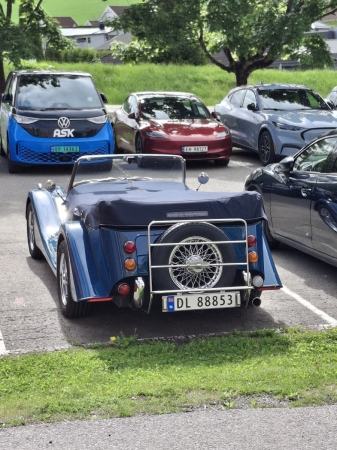
My feeling is that classics are best left as classics. If you want an EV then buy a modern car. Ideally have both. That has been mine recent philosophy, when I replaced my 2013 Seat Leon with a new Seat Leon PHEV. So I can drive the Morgan for the trad experience and the Seat for more modern conveniences. A PHEV removes range anxiety and for me, with my normally relative short journeys I find I use the PHEV in electric mode pretty much all the time. This thread asked the question, is it a good idea to convert a classic into an EV. For me, that would have to be - is it a good idea to convert a classic into a PHEV. And I'm sure the answer must be no - as there can't possibly room for both battery and petrol power in most classics.
But it works reasonably well in my modern Seat. So my answer is keep the classic and spend the conversion cost on a modern PHEV.
Here's some data on my experience with the Seat PHEV for those interested:
Seat Leon 1.5 FR PHEV. This car cost £33k, new. I’m more or less happy with it, but it feels bigger (it’s not) and heavier (it is) and a lot more complex than my previous Leon. The EV function works very well. In petrol mode I’d much rather be driving a Morgan.
It is a 5-seater hatchback with a 1498cc 4-cylinder turbocharged petrol engine (110 kW, 140 bhp, ?lb-ft) and an electric motor (85 kW, 116 bhp, 243 lb-ft), providing a combined power output of 204 bhp. Front wheel drive, 6-speed DSG automatic gearbox.
I’ve driven 2000 miles so far, about 1600-1800 was in pure EV mode. That consumed 830 kWh, so I was getting 60 miles or 100 km for each 25 kWh of charge. On Octopus overnight charge that cost 7p/kWh, so a total of 60£ or 3p per mile. That compares to 14p per mile when using petrol.
It is 4.37m x 1.80 x 1.46 m (length/width/height). My previous Leon (2013) was 4.23 x 1.81 x 1.44 m. It’s hard to believe the new car is only 14 cm longer and 2 cm higher – it seems much bigger, particularly in height.
The first year’s road tax is £110, and then it is £195.
My insurance premium is about £350. (That’s the same as all 3 morgans put together!).
It has a 25-kWh battery (408 V), but only 20 kW of this is visible to the driver. I’m guessing the rest is held in reserve to prevent completely emptying the battery and so that power is always available to run the systems. (Or maybe the spec I read is wrong and it is actually a 20-kWh battery, hard to tell from the docs). There is also a conventional 12V battery in the boot.
Driving in electric-only mode, you consume about 30 kW/100m around town. At 80% charge on a 10 °C November day, you therefore get about 45 miles of local range. Longer distances are slightly better (but not much).
The petrol tank is 40 litres, giving a petrol-only range of 400 miles.
Performance is 0-60 mph in 7.5 seconds, top speed 137 mph, power to weight 120 bhp/tonne, with combined power of 204 bhp and combined torque of 258 lb-ft (350 nm).
In combined EV/petrol mode, it is moderately easy to spin the front wheels under full acceleration, and it certainly seems very quick – but not very pleasant and you’d never do that normally anyway.
It is very pleasant to drive in normal (ie non sport, non-manual) battery mode. It is very quiet (as you would expect) so wafting about town is entirely relaxing. There’s not much windo or tyre noise either at normal speeds on country roads, so again it is a pleasant, somewhat insulated experience, driving at higher speeds on A or B roads.
The petrol engine effectively does nothing in battery mode – and provided you do short journeys (e.g. up to 40 miles a day) and recharge overnight, you can easily go a week or two or more without consuming any petrol at all. I have stopped at Sainsbury’s a couple of times, thinking I’ll just top the tank up to find that the tank was already full.
Charge time (at 7kW, i.e. a wall charger): 3.7 hours
Charge time (at 2kW, i.e. 13A mains plug): 10 hours
The max charge rate that the car will accept from a domestic wall charger is 11 kW but to get this in a domestic environment will require a 3-phase domestic supply being available at the house. My wall box is limited to 32A (7kW) so it takes about 3-4 hours to charge at home.
Motorway chargers provide 400V DC, allowing a 50-kW charger to recharge the car battery in roughly 30 minutes. (Higher charge rates are available but I don’t think the Seat Leon PHEV can accept more than 50 kW). My experience is that the charge time is more like 50 mins on a 50-kw charger. But why would you ever bother? Since it is a PHEV, you can just drive it normally on the petrol engine, and since motorway chargers are twice as expensive per mile as petrol that is the cheapest option anyway.
Seat quoted an EV range of 81 miles, but this is really an imaginary figure. I think the best I have seen using 100% of the battery is 65 miles. But typically, you only charge to 80% of the max battery capacity, so realistically, the battery-only range is 50 miles in warm weather and maybe 40 miles in winter.
IFrom 26 Sept to 1 Jan the statistics are:
Average fuel consumption: 150 mpg
Average energy consumption: 33 kwh/100k
Driving time 3 days 13 hours
Distance 1673 miles
Average Speed 19 mph
In this period, I used: 11 gallons of petrol £70
883 kW of electricity £61
I think to do a similar mileage in my previous petrol only Seat Leon would have required 40 gallons of petrol – so roughly speaking, I’ve reduced my CO2 emissions by 75%. (but of course more CO2 might have been needed to build and scrap this car than the previous one).
If there is no power in the battery, the car typically does 50 mpg on petrol, so 13p per mile for petrol at £6.30 per gallon. On Octopus EV tariff, the cost is 7p per kwh, so that is also 4p per mile. So, fuel costs in battery only mode is approximately 30% that of petrol only mode.
All of these consumption/mileage numbers are a bit approximate as the different ways of measuring/reporting them don’t quite agree.
So, very roughly speaking, if the additional EV stuff (battery/motor/controllers) adds £5k to the purchase price and you save 8p per mile, by running on cheap overnight electricity, then it takes 5000/0.08 = 62000 miles to recover the additional capital cost in buying a PHEV.
That does not account for the possible need to replace the battery or motor during that period. We might expect the battery to last for perhaps 2000 cycles. At 33 kwh each 100 km, that means the battery will complete 2000 cycles after a total mileage of 20 kwh * 2000 / 33 kwh * 100 km = 120000 miles. No idea how long lasting the electric motor is, but the internet suggests this might be of the order of 200,000 miles. So, it seems the extra capital cost of a PHEV is recovered well before the battery/motor needs replacing. Maybe.
Driving Experience
In manual or sport mode, the accelerator sensitivity is a bit too high for my taste, as the small changes in accelerator position result in too immediate responses.
In EV mode, it’s a very pleasant drive. The cabin is nicely appointed and comfortable. I doubt it is very different from a Golf or an Audi 3 in terms of comfort or driving experience.
I quite like the regenerative braking, particularly as the car often seems to know when it is approaching a roundabout or junction and will do some of the braking pre-emptively.
That being said, the actual driving experience is not very involving or exciting. The power steering deadens a lot of the feel from the road, and the car does not really invite spirited manoeuvring in the corners. But as a comfortable means of getting from A to B it does a good job.
Good things
Automatic lights work well.
The ability to remotely preheat the cabin is lovely – particularly with ice on the windows.
The boot is smaller than normal, because of the battery, but the back seats fold down nicely so I have not found it a problem.
Brilliant build quality (as per most modern cars, but brilliant nevertheless). Perhaps not quite as good as my previous Leon.
Complaints
Despite being set to UK units a few things are reported in kilometres (e.g. power per kilometre).
There are way too many different symbols/lights/gauges presented on the driving display. The driving display has multiple display modes and is just too complex to digest easil. I find it more of a distraction rather than an aid when driving. So, complex I would say it is a safety hazard). This, for me, is probably the worst thing about the car.
High beam: you need to hold the lighting stalk in the high beam position for a short period for high beam to be selected, rather than just dab it in that position. This is very annoying as it often means I need to have two goes at selecting high beam.
Traffic sign recognition: This sometimes reports speed limits read from side roads rather than the road you are driving on. It does not detect traffic lights (I guess they are not really a traffic sign, but it would be very useful if it did recognise them). Pretty sure all the driving aids will happily let you go through a red light, though I’ve yet to try it.
The steering wheel is not on the centre line of the driver’s seat. This seems to be true of most modern cars.
The petrol gauge reports miles remaining (which can change depending on how many mpg it thinks your current driving style is going to get). So, it’s pretty hard to calculate how many gallons you can put in when filling up.
The wall charger (HyperVolt)/Octopus/Leon integration is very poor – the various units do not understand each other and generate spurious error messages which you have to ignore. I wonder though how you debug an error when you can’t trust the error messages. It does charge reliably overnight though, most of the time. This is not really a Seat problem I feel.
The audio entertainment system is okay – but could produce clearer speech and music. But that may be a function of my deteriorating hearing. I did not go for the 3k£ Bose upgrade.
The driving assistant functions are a mixed blessing. Eg ‘Lane crossing’ detection requires you to indicate on every lane change (otherwise it thinks you are asleep and are unintentionally crossing the white line). The Adaptive Cruise Control is nearly very good, but it does not account for other vehicles in the adjacent lane on a Motorway so I can see situations where it could get you into trouble (e.g. a car cuts across in front of you at a slip road). Generally, I find the assistant functions increase my anxiety level. The collision avoidance warning safety assist will detect possible collisions (but apparently only 19 mph) but also goes off occasionally in situations which seem inappropriate to me. I’ve not been brave enough to drive at something and see how well it actually brakes the car. On balance though, it’s probably a good thing to have.
Other comments
The tech specs are somewhat opaque. Ie I’ve no real idea of how the electric and petrol motor interact. The user manual is good but does not really deal with all the complexities of the car.
No spare wheel – but that is the modern trend. And I probably could not undo the wheel nuts these days anyways.
Sporty tyres, ie low profile – they seemed to be poor in the recent/frosty/icy conditions.
Allow wheels never look clean, even after a car wash.
Not sure it’s going to cope well with ice/snow – very heavy. ABS and ESC fires easily on icy roads (but not on wet ones).
Service interval – this is admirably long – 2 years or 18000 miles
Just my experience - your mileage may vary .....