It's worth remembering that supermarket fuel has to meet the same super strict British standards as all other fuels, these standards are extremely rigorous so people should not be put off by buying fuel from a supermarket fuel station.
In my experience what kills lambda sensors in short order is lots of cold starts, and stop start driving. The worst case scenario being starting an engine, moving a car a short distance then switching it off so never giving it enough time to fully warm up. Just like a spark plug, lambda sensors are self cleaning, that is you need to get them hot to perform their self cleaning function, if they never get to the critical self cleaning temperature eventually all those super rich condition cold starts will poison the lambda sensor and a error code will follow.
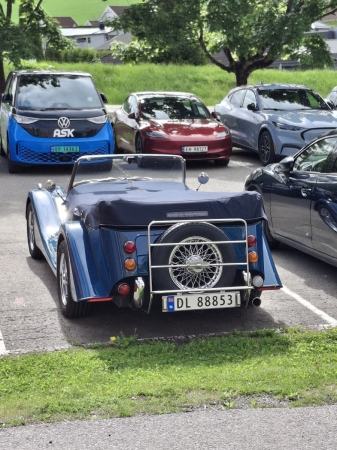
The OP's Morgan has only done 2,000 miles, on the face of it you'd think the lambda sensor would last a lot longer than that, but it's actually the low mileage that points to why it failed. I suspect the car sat in a dealer’s showroom for a long time, and the dealer was shuffling his cars about as they do. All those super rich condition cold starts and short drives while failing to fully warm up the engine are what most likely killed the lambda sensor, the failure is actually an indirect consequence of the low recorded mileage not a reason to be disappointed with the lambda sensor's perceived short service life.
It’s also worth pointing out the Duratec Plus 4 runs an ancient technology narrow band lambda sensor that can only read, or is at least only accurate at stoichiometric ie 14.7:1 AFR. This in itself can mean big lean/rich swings in AFR and is not good for lambda sensor life, older narrow band lambda sensors are also fundamentally not as robust as more modern wide band lambda sensors like a Bosch LSU 4.2, or the even more robust and newer LSU 4.9 I run in conjunction with my ECU Masters EMU Black plug and play ECU.
As we can see there's a lot more to consider here before laying the blame at the door of supermarket fuel, which at the end of the day has to be very high quality or it would never reach the very strict British standards it must pass before being sold to the general public.
My final point would be you can actually clean poisoned lambda sensors and often with good results, if the OP had carefully cleaned his sensor and then taken his Morgan for a good old traditional ‘Italian Service’ (get the engine properly up to temp and drive it under load) then he probably could have saved himself the cost of a new sensor. The easiest way to clean the Lambda Sensor and catalytic converter that can also become poisoned for the same reasons, is by using a good quality catalytic converter and lambda cleaner fuel additive into the fuel tank, although removal and soaking the sensor in a suitable agent for a couple of hours tends to work best.