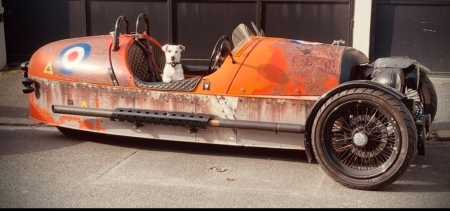
I really don't want to get into a debate over emissions, because clearly that's not what the 'Monty Takes a Deep Breath' post is about, the reason for studying Monty's exhaust system is merely part of an investigation.
Previously we were running Monty on Newman Phase 2 cams which are what I'd describe as 'Mild Fast Road', we combined these with a custom 4 into 2 into 1 long equal length 42mm id primaries exhaust manifold made by Matt at Fusion Fabrications, and on the other side we used his proven long runner inlet also with 42mm id runners. The objective was always torque over peak horsepower, and we certainly achieved our goals. However, we were surprised to see Monty's power dramatically falling away above 5,500rpm? The 172hp peak was not what we expected, all our calculations and referencing the many Duratec engines tuned with this exact same recipe said Monty should have made 203hp at 7,250rpm.
Our focus turned to finding the missing 18% at peak, the dyno graph clearly revealing a breathing issue above 5,500rpm

With the inlet and exhaust manifolds left unchanged, we set about giving Monty even more airflow. A fully hand ported cylinder head from A.L Developments was specified, this was upgraded further with 1mm larger inlet and exhaust valves. We even took the exhaust ports out from 38mm to 40mm, and to take advantage of all the extra airflow we then fitted a set of proper 'Fast Road' cams (Newman Phase 3). The bigger valves in Monty's new heavily worked and optimised cylinder head are now being lifted further off their seats, held open longer, and the time the inlets and exhaust valves stay oped at the same time (overlap) was increased too.
The resulting airflow this revised package now offers is huge, with the new head and cam package thought to be perfectly capable of supporting 280hp to 300hp. Essentially we took a standard Duratec head which is already a highly efficient design, and threw everything at it. We were also careful to revisit throttle body, inlet runner and exhaust primary size to ensure they would support our power goal of 220hp, which they are. The standard throttle body on a Duratec Plus 4 comes straight off a Ford Mondeo making 145hp, however, it is well understood a 2.0-liter four-cylinder engine with a single 55mm throttle body can realistically support a maximum of 230 to 250 horsepower in a naturally aspirated (N/A) application before becoming a noticeable airflow restriction.
Monty's inlet runners have an ID of 42mm, four 42mm inlet runners on a 2.0-liter 4-cylinder engine can support 240 to 250 horsepower in a highly optimised naturally aspirated engine. Monty's exhaust primaries also have an ID of 42mm, again in a highly optimised, high-performance build four 42mm Inner Diameter (ID) exhaust primaries will support approximately 280 to 320 horsepower on a 2.0-litre four-cylinder engine. And finally Newman themselves confirmed a set of their Phase 3 (PH3) cams on a naturally aspirated 2.0-litre Ford Duratec HE engine will easily support 230hp. The Newman Phase 3 cams are actually a tiny bit more aggressive than Caterham 420R cams, and while a Duratec in a 420R comes with 210hp as standard, Northampton Motorsports have tuned many 420s to over 225hp without resorting to changing the cams, so I'm very confident my Newman Phase 3 cams will easily support our 220hp goal for Monty.
The idea was to give Monty more cylinder head than he really needs, then fit the least aggressive cams we can that will still support and slightly exceed our 220hp goal, equally, we also wanted to use the smallest inlet runners and exhaust primaries that will still support and slightly exceed out 220hp goal. The reason being, is we want Monty to deliver the best torque possible, and over the widest window. The way to achieve this is to keep air and exhaust gas velocity as high as possible without restricting power below the target 220hp, we then built in a 10hp over target buffer for good measure rather than trying to run the setup at the bleeding edge of its 230hp breathing limits.
While we're trying to achieve 220hp, we've actually built Monty's Duratec to be airflow limited at 230hp, more specifically here are breathing capabilities of each key airflow component used on Monty's stage 3 engine build, and to remain conservative I'm showing the lower minimum numbers:
* Cylinder head = 280hp
* 42mm id exhaust primaries = 280hp
* 42mm id inlet runners = 240hp
* 55mm throttle body = 230hp
* Newman Phase 3 cams = 230hpWhile the 55mm throttle body will limit power at 230hp, given I would consider this more than sufficient in a trad chassis Morgan and knowing it could easily support our 220hp target, we decided to retain it for more control, better throttle response and torque production. For the same reasons inlet runners and exhaust primaries were kept at 42mn id for good air and exhaust gas velocity, which also produces better response and torque.
At this point it's worth reminding ourselves, tuning a 2.0 Ford Duratec is a very well trodden path, the results you can expect are therefore also extremely well documented. To demonstrate this, let's look at some examples of cars fitted with a Duratec that have enjoyed similar tuning work to Monty.
![[Linked Image]](https://i.ibb.co/FqY4R6Vc/Screenshot-20260823-143148-Firefox.jpg)
As we can see, all these Duratecs continue to make power from 5,500rpm to at least 7,500rpm, if I lay their dyno graphs over Monty's latest graph, what you actually notice first is from 3,500rpm to 5,500rpm where you typically play with the engine during fast road driving, Monty is actually already the top performer in the pack. This is especially satisfying to see as he achieves his superior mid range punch without the benefit of the variable valve timing on BBRs Super 225 and Frontline's setup too, if you then consider the significant weight advantage Monty has over these two examples you should start to get a feel for Monty's current real world performance.
The truth is, from idle to 5,500rpm Monty is already very much doing what we designed him to do. With the exception of the feather light Caterham 420R, if the 930kg Monty was in a dog fight on a winding road with this lot he would absolutely destroy the competition from idle to 6,000rpm. All Monty is actually missing is the ability to keep piling on horsepower over 5,500rpm, which is odd given we've carefully build his Duratec to peak at 230hp @ 8,250rpm, but with an achievable 220hp @ a super safe 8,000rpm target in mind.
Everything is in place to allow Monty's Duratec to wind out to 8,250rpm, which we've already proven it happily does. With his new head and Phase 3 cams power no longer falls off a cliff at 5,500rpm, it just stays flat around 180hp over a massive 2,000rpm plus window instead of continuing to naturally climb above 5,500rpm to over 8,000rpm as it should????
Something is clearly holding Monty's Duratec back around 5,500rpm, we saw this before when he was on the Phase 2 cams, and we're seeing the exact same thing again after fitting the fancy ported head and Phase 3 cams. So if Monty definitely has the lungs the inhale sufficient air to support 230hp, why can't we get him past 180hp, and what the hell has been happening at 5,500rpm right from the outset of my tuning journey that's so clearly holding him back?
With my ECU logs showing the inlet manifold hols atmospheric pressure at wide open throttle all the way out to 8,250rpm, the answer has to lie in Monty's ability to exhale. More specifically, the issue must lie in his inability to evacuate the enormous volume of exhaust gas Monty is now producing when his highly optimised Duratec starts pumping over 5,500rpm. With the exception of his little sports cat that I asked Matt at FF to fit, Monty's exhaust system has a 63mm id bore from front to back, and a single, straight-through 63mm (2.5-inch) exhaust system on a 2.0-litre four-cylinder engine will efficiently support 350hp to 400hp. This is why my attention has now turned to the little sports cat, which as we can see is actually considerably smaller than what Ford deemed necessary to support just 145hp, our expectation that this little sports cat would support 215hp to 220hp was optimistic at best, and more realistically, very likely an error of judgment

![[Linked Image]](https://i.ibb.co/5WNL2vyy/Screenshot-20260830-120109-Whats-App-1.jpg)
On a positive note as covered above, the rest of Monty's breathing capacity is for sure 230hp sound, so there's no question he has the lungs to comfortably hit our 220hp target. Better still, building a 63mm straight though de-cat pipe is an easy mod that I can fit in under 30 minutes, and then test at Surrey Rolling Road one Saturday morning for just £55.00.
Watch this space folks