With regards to your point on renewables due to their on / off delivery capacity, no solar at night, no wind power when not windy. To make it worthwhile for companies to run Nuclear or hydrocarbon stations you have to use them during the day and turn off the renewables at times as the other power station owners would close down the hydrocarbon and nuclear stations as the could not cover running costs. They would also no replace ageing stations as the need replace.
Nearly right. Nuclear power stations have to run full bore (or very nearly so) all the time, 24/7. You can't turn them up or down. For this reason they are relied on to support the demand that's always present, no matter what time of day. This is called Base Load, and it's one reason why EVs charging overnight hold no great problems as far as the National Grid is concerned as all you are doing is making better use of the base load distribution.
When the wind is blowing and the sun is shining, renewables produce very cheap power that can be used to fill in the peaks of demand. They are very easy to turn off as you can feather the blades of the turbines when you don't need the power or just spill the output from the solar panels.
Their big problem of course is that you can't turn them on at will if there isn't any wind or sun. A good geographical spread of them helps of course but that's why we still need gas as it's especially turn off and on-able. Coal stations are also very flexible, but of course very dirty in comparison.
That's why strategy is currently ⅓ Nukes, ⅓ Renewables, and ⅓ gas. On the wholesale markets it's the hydrocarbon stations that are the price makers (ie they will only run when the price is right) whereas Nukes and Renewables are price takers (ie they will run as much as they can, hoping to get enough income to cover their costs).
This is why the price of electricity is almost entirely dependent on the wholesale price of gas.
Back to Hydrogen production - if you put a hydrogen cracking plant next to a Nuclear power station, it would actually be very attractive from an energy strategy point of view, as it would enable the power station to become more flexible - it could produce cartloads of power when needed, and when not you just divert it into hydrogen production.
What's stopping this? 2 things: firstly hydrogen doesn't hold out the promise it used to dues to energy density and transport issues, and secondly battery technology is advancing extremely fast in terms of capacity, lifespan and recyclability. That's why the investors are backing battery rather than hydrogen. They could be wrong, and although markets can go horribly wrong in the short term (tulip bulbs) they very rarely do over decades. Batteries are wher it's at as far as they are concerned.
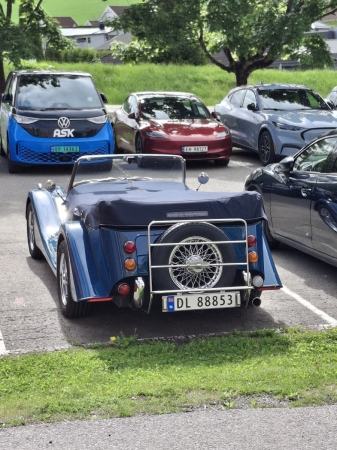
I still think the obvious thing for MMC to be doing at the moment is to put a well-proven hybrid drive train into an aero chassis. It's what they've been given money to do by the Government, and of course BMW have a couple of well-proven versions.
If I was a betting man I'd be putting money on an i8 drivetrain (or variant of it) in an Aero being announced at the 2019 Geneva show.