It probably has more to do with the Winter Solstice than the actual birthday of Jewish boy in Roman ruled Palestine 2000 odd years ago.
Why is Christmas in December
In the 3rd century, the Roman Empire, which at the time had not adopted Christianity, celebrated the rebirth of the Unconquered Sun (Sol Invictus) on December 25th. This holiday not only marked the return of longer days after the winter solstice but also followed the popular Roman festival called the Saturnalia (during which people feasted and exchanged gifts). It was also the birthday of the Indo-European deity Mithra, a god of light and loyalty whose cult was at the time growing popular among Roman soldiers.
The church in Rome began formally celebrating Christmas on December 25 in 336, during the reign of the emperor Constantine. As Constantine had made Christianity the effective religion of the empire, some have speculated that choosing this date had the political motive of weakening the established pagan celebrations. The date was not widely accepted in the Eastern Empire, where January 6 had been favored, for another half-century, and Christmas did not become a major Christian festival until the 9th century.
Then there are the Celtic traditions.
1. Leaving a candle in the window of the house to guide Mary and Joseph on their way to Bethlehem to give birth was inspired by an old Celtic ritual of lighting a way for the spirits to pass peacefully.
2. Hanging the holly and ivy wreath outside the house. In pre-Christian times they warded off evil spirits. In modern day the holly represents the crown of thorns, the ivy the pre Christian era.
3. Mistletoe in the druid tradition was a symbol of male fertility. It was hung in the house and the man had the right to kiss any girl that stood under it. The tradition continues today.
4. Burning the Yule log in the fire is a pre Christian rite of honor to the Mother Goddess. Today in Ireland a fire on Christmas morning is traditional in many homes regardless of weather.
5. Decorating the Christmas tree was originally a pagan Irish celebration. Decorations celebrated the three deities, the sun, moon and star and some decorations represented the souls of those who died.
6. The giving of Christmas gifts relates to the winter solstice which was a time when gifts were exchanged between clans and chieftains as a means of renewing ties and friendship.
7. Chasing the wren. Legend had it that the martyr St. Stephen was betrayed by a wren when he was hiding in a bush. The ritual involves gangs of youths in rural Ireland hunting a wren on December 26th, St.Stephen’s Day.
8. Eating mince pies. According to historian Melissa Snell, mince pies (so called because they contained shredded or minced meat) were baked in medieval times in oblong casings to represent Jesus' crib, and it was important to add three spices (cinnamon, cloves and nutmeg) for the three gifts given to the Christ child by the Magi. The pies were not very large, and it was thought lucky to eat one mince pie on each of the twelve days of Christmas (ending with Epiphany, the 6th of January).
9. The date of Christmas was most likely taken from the Celtic winter solstice.
"It is cosmic symbolism ... which inspired the Church leadership in Rome to elect the winter solstice, December 25, as the birthday of Christ, and the summer solstice as that of John the Baptist, supplemented by the equinoxes as their respective dates of conception,” says historian S E Hijmans
10. Food left for Santa Claus comes from the Gaelic tradition of leaving food for Mary and Joseph on their journey to Bethlehem.
So I would like to wish everyone a happy and merry Winter Solstice on the 22nd of December.
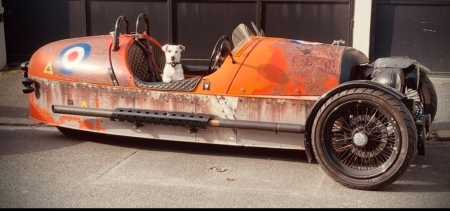
This, of course, means that the days will start to get longer and we can start to look forward to getting out in the Morgan with the top down








![[Linked Image]](http://bradley.it/public_images/drive.jpg)
