Thanks Peter for WMD = Weapon of Mass Destruction, makes sense now.
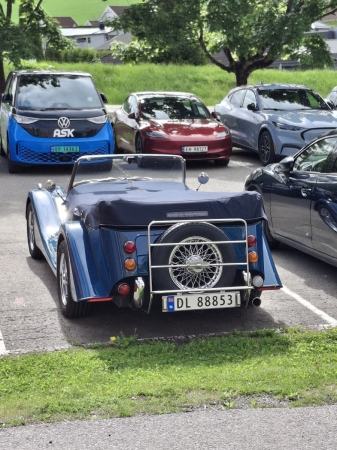
Neilda - nice pictures, I love the GT40
Chris, if you installed solar panels a Tesla could be charged for free + plus there are many free destination chargers in OZ and full EV's also have much reduced service requirement.
regarding the $0.025/km has not yet been passed by parliament and thus not implemented.
I thought the 2.5 Cents per KM was a state charge and already started in SA, VIC and potentially other states will follow. I guess we need to wait and see what happens with it.
My son is a registered mechanic and I generally do my own servicing so not worried about service costs that much. But I agree an EV should be cheaper.
I have solar panels which sort of adds to my problem. I installed a 1.5KW system in 2010 for $4900 at the 47cent feed in. At that time I was paying 15cent per KW so a very good deal. Two independent meters on the house, say I generated 100Kwh ins a charging period and used 400Kwh my bill would be 400 * $.015 less 100 * $.47 = $60 - $47 = $13. Those types of deals disappeared about 10 years ago, I have a 20 year contract with 10 years to go but if I change anything they cancel it. Generally each year it generates about $800 of credit so it has paid for itself and from now on it is just free money as long as it keeps working, last month I noticed it not working and had to pay $319 to get a faulty switch on the roof replaced which means losing about 40% of this years credit, hopefully nothing else goes wrong. I am now paying $0.23 per Kwh but still getting $0.47 for each Kwh generated.
Based on that any EV would be charged from the $0.23Kwh tariff and the panels just charging the grid at $0.47 which gives me the best money from the setup. So no difference in cost for an EV if I didn't have panels. The question is how long should I keep the system? It is a good rate but a fairly inefficient system compared to what I can get now.
I installed a 6.6Kwh system at my rental property my son lives at. It cost me $14,000 although part of that was upgrading the metre and fuse box. He pay $0.21Kwh and gets $0.08Kwh for any excess. So in his case it makes sense to use as much power during the day as possible to save 21cents rather than 8 cents. If he owned a Tesla then he could charge it during the day and really only pay $0.08 for each Kwh (as he would not get paid for back to the grid) however he is out working all day so chances are the car would get charged at $0.21 most of the time.
As you say there are free chargers out there, NRMA for example which is the best option to use. I heard Tesla Australia advertising that people can plug their other cars into a Tesla Supercharger if they want, based on their charge of 52 cents per KWh I am not surprised they are happy for anyone to use it.
I expect the system at my sons place to save him about $2,000 to $3,000 a year so pay for itself in 5 to 7 years, as the warranty on all the components are 25 years it means it will be well and truly paid for itself about 4 times before it might cost money in repairs. Seems like a good way of giving my son some of his inheritance early.
I thought about putting a battery onto my sons house and chose an invertor that can have a battery plugged into it, but for a 13.3KW battery the cost is $16,000. Assuming it got charged fully every day and fully used every night it would save 13.3Kwh by $0.21 less $0.08 or 13.3*(0.21 - 0.08) = $1.73. For 365 days that is = $631.54 Based on $16,000 and a 10 year warranty that is means it will pay for itself in 25 years or 2.5 times the warranty period. I seriously doubt it would last long enough to pay for itself so not a good investment, the only tangible benefit is not losing power in an outage but in 20 years I think we have had three outages (unlike the UK in the 1970's when I was a kid and we lost power at least 3 times a week). The price needs to drop to 1/3rd for my maths to want to get one. Hopefully one day the maths for putting on a backup battery will make sense as batteries get cheaper.
I keep seeing headlines like New Battery tech will soon make EV's as cheap to buy as a petrol car, but is that really true? Take a Toyota Corolla in Australia, one of the best selling cars. Brand new ranges from $23,000 to $39,000 for a Hybrid with all the bells and whistles. The cheapest Tesla is the 3 at $70,000 in white without the long range battery or any other features. The battery is supposed to be worth either $7000USD or $16,000USD depending on what I read, basically $10,000 to $20,000 AUD. So even using the highest cost of $20,000 and Elon Musk can work out how to make free batteries the Tesla 3 would still be over $50,000AUD, making it more expensive that the most expensive Toyota Corolla and double the price of the cheapest. I am sure the Tesla 3 is a better car than a Toyota Corolla but Elon has a lot of work to get the cost of the cars down to Toyota Corolla price if he wants to sell to the masses. He can't rely just on battery prices dropping, even if they dropped to 1/3rd it is still expensive compared to a petrol car.
In 5 years when my Octavia reaches 10 years old and my panels 15 years old I am hoping that panels will still be a great option but by then so will the backup battery. It will be worth replacing the existing system and getting out of the contract. While I would consider a Tesla 3 now if the Octavia was written off hopefully in 5 years there will be a stack of electric car options to chose from and that is when I will probably replaces solar system and my car.
What I really want is a Tesla car that can be used as a back up battery, plug it in during the day when home and charge it up fully then use it to run the house at night. With a 75Kwh battery even if i used 20Kwh's at night that leaves over 50 to use for driving the next day. I talked to the Tesla dealer and they said not the car can't do that and they don't plan on changing it so it can be used as a back up battery. Pity otherwise people could use the free NMRA chargers at the shops to charger their Tesla free and get very low power bills